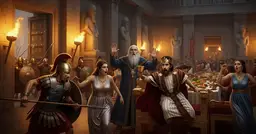
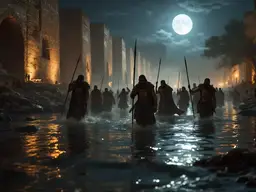
 12/10/539 BCE. The festival of Akkitu. Gobryas leads a commando of elite Persian Immortals who have just emerged out of the darkness of the riverbed into the Babylonian palace to assassinate Belshazzar..Google Imagen 4.0 Ultra https://creator.nightcafe.studio/creation/F6JlER7IBGRLFB1Y1B3x 12/10/539 BCE. The festival of Akkitu. Gobryas leads a commando of elite Persian Immortals who have just emerged out of the darkness of the riverbed into the Babylonian palace to assassinate Belshazzar..Google Imagen 4.0 Ultra https://creator.nightcafe.studio/creation/F6JlER7IBGRLFB1Y1B3x | 1210539-bce-the-festival-of-akkitu-gobryas AIART CC-BY Lyle Southwell.upsc.webp.webp |
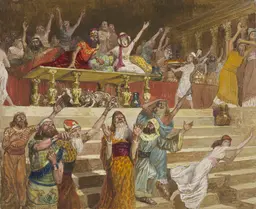 James Jacques Joseph Tissot (French, 1836-1902) and followers.The Writing on the Wall (Mané, Thécel,Pharès).https://thejewishmuseum.org/collection/26639-the-writing-on-the-wall-mane-thecel-phares James Jacques Joseph Tissot (French, 1836-1902) and followers.The Writing on the Wall (Mané, Thécel,Pharès).https://thejewishmuseum.org/collection/26639-the-writing-on-the-wall-mane-thecel-phares | 26639-the-writing-on-the-wall-mane-thecel-phares TRADART PD.jpg |
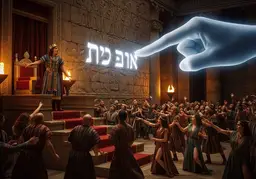
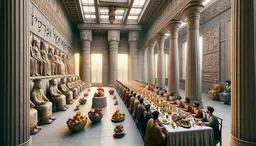 Daniel 5. The writing on the wall during the banquet of Belshazzar on the eve of the fall of Babylon. The writing is in Aramaic words even though the text was probably not in that language since it was the preferred language of the wise men in Babylon (Dan 2:4). Bible Illustrations. AI-generated image using ChatGPT-4 / DALL-E 3. Prompt by Tor Tjeransen. Daniel 5. The writing on the wall during the banquet of Belshazzar on the eve of the fall of Babylon. The writing is in Aramaic words even though the text was probably not in that language since it was the preferred language of the wise men in Babylon (Dan 2:4). Bible Illustrations. AI-generated image using ChatGPT-4 / DALL-E 3. Prompt by Tor Tjeransen. | AME_100128322_DALL·E 2024-04-17 13.29.38 CC-BY Tor Tjeransen (AME-AI).jpg |
 Daniel 5. The writing on the wall during the banquet of Belshazzar on the eve of the fall of Babylon. The writing is in Aramaic words even though the text was probably not in that language since it was the preferred language of the wise men in Babylon (Dan 2:4). Bible Illustrations. AI-generated image using ChatGPT-4 / DALL-E 3. Prompt by Tor Tjeransen. Daniel 5. The writing on the wall during the banquet of Belshazzar on the eve of the fall of Babylon. The writing is in Aramaic words even though the text was probably not in that language since it was the preferred language of the wise men in Babylon (Dan 2:4). Bible Illustrations. AI-generated image using ChatGPT-4 / DALL-E 3. Prompt by Tor Tjeransen. | AME_100128323_DALL·E 2024-04-17 13.26.13-2 CC-BY Tor Tjeransen (AME-AI).jpg |
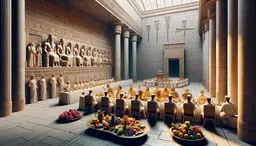 Daniel 5. The writing on the wall during the banquet of Belshazzar on the eve of the fall of Babylon. The writing in this image consists of four cuneiform signs. The writing might have been in cuneiform script. The text was probably not in Aramaic since that was the preferred language of the wise men in Babylon (Dan 2:4), but they did not understand this writing. For more information on this suggestion see: David Instone Brewer, “Mene Mene Teqel Uparsin: Daniel 5:25 In Cuneiform”, Tyndale Bulletin 42.2 (Nov. 1991) 310-316. Bible Illustrations. AI-generated image using ChatGPT-4 / DALL-E 3. Prompt by Tor Tjeransen. Daniel 5. The writing on the wall during the banquet of Belshazzar on the eve of the fall of Babylon. The writing in this image consists of four cuneiform signs. The writing might have been in cuneiform script. The text was probably not in Aramaic since that was the preferred language of the wise men in Babylon (Dan 2:4), but they did not understand this writing. For more information on this suggestion see: David Instone Brewer, “Mene Mene Teqel Uparsin: Daniel 5:25 In Cuneiform”, Tyndale Bulletin 42.2 (Nov. 1991) 310-316. Bible Illustrations. AI-generated image using ChatGPT-4 / DALL-E 3. Prompt by Tor Tjeransen. | AME_100128324_DALL·E 2024-04-17 13.29.38 Cuneiform1 CC-BY Tor Tjeransen (AME-AI).jpg |
 Daniel 5. The writing on the wall during the banquet of Belshazzar on the eve of the fall of Babylon. The writing in this image consists of four cuneiform signs. The writing might have been in cuneiform script. The text was probably not in Aramaic since that was the preferred language of the wise men in Babylon (Dan 2:4), but they did not understand this writing. For more information on this suggestion see: David Instone Brewer, “Mene Mene Teqel Uparsin: Daniel 5:25 In Cuneiform”, Tyndale Bulletin 42.2 (Nov. 1991) 310-316. Bible Illustrations. AI-generated image using ChatGPT-4 / DALL-E 3. Prompt by Tor Tjeransen. Daniel 5. The writing on the wall during the banquet of Belshazzar on the eve of the fall of Babylon. The writing in this image consists of four cuneiform signs. The writing might have been in cuneiform script. The text was probably not in Aramaic since that was the preferred language of the wise men in Babylon (Dan 2:4), but they did not understand this writing. For more information on this suggestion see: David Instone Brewer, “Mene Mene Teqel Uparsin: Daniel 5:25 In Cuneiform”, Tyndale Bulletin 42.2 (Nov. 1991) 310-316. Bible Illustrations. AI-generated image using ChatGPT-4 / DALL-E 3. Prompt by Tor Tjeransen. | AME_100128325_DALL·E 2024-04-17 13.29.38 Cuneiform2 CC-BY Tor Tjeransen (AME-AI).jpg |
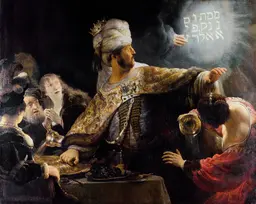 | Belshazzar’s feast (from 1634 until 1639) Rembrandt van Rijn TRADART PD.webp |
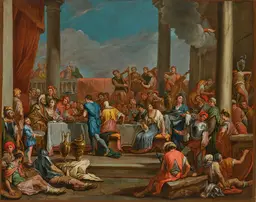 | Belshazzar’s Feast Giulio Carpioni TRADART PD.webp |
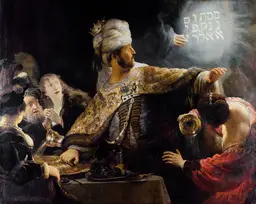 | Belshazzar’s feast Rembrandt van Rijn TRADART PD.jpg |
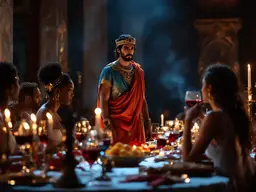 | belshazzars-feast-ii AIART CC-BY Lyle Southwell.upsc.webp |
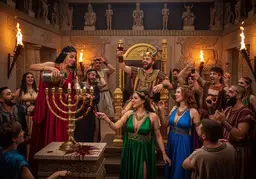 | last-night-in-babylon-daniel-5 XX AIART CC-BY Lyle Southwell.upsc.webp |
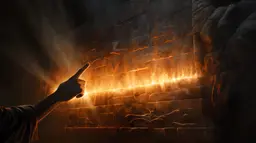 | MidJourney albrunelli_photorealistic_scene_finger_of_God_writing_on_a_temp_2c649d4e-0c41-468e-9c8a-b750c3155f3f.upsc.SwinIR.webp |
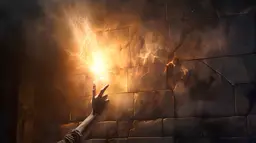 | MidJourney albrunelli_photorealistic_scene_finger_of_God_writing_on_a_temp_37c029f7-7960-401f-a21b-c9d83510fbfc.upsc.SwinIR.webp |
 | the-fall-of-babylon-under-cyrus-the-great AIART CC-BY Lyle Southwell.upsc.webp |
 | the-writing-on-the-wall AIART CC-BY Lyle Southwell.upsc.webp |
| the-writing-on-the-wall.upsc.webp |
 James Jacques Joseph Tissot. Public Domain Image from The Jewish Museum. James Jacques Joseph Tissot. Public Domain Image from The Jewish Museum. | Tissot 26639-the-writing-on-the-wall-mane-thecel-phares TRADART PD.webp |
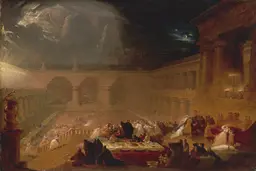 | Wikimedia John_Martin_-_Belshazzar's_Feast_-_Google_Art_Project TRADART PD.jpg |
 12/10/539 BCE. The festival of Akkitu. Gobryas leads a commando of elite Persian Immortals who have just emerged out of the darkness of the riverbed into the Babylonian palace to assassinate Belshazzar..Google Imagen 4.0 Ultra https://creator.nightcafe.studio/creation/F6JlER7IBGRLFB1Y1B3x
 James Jacques Joseph Tissot (French, 1836-1902) and followers.The Writing on the Wall (Mané, Thécel,Pharès).https://thejewishmuseum.org/collection/26639-the-writing-on-the-wall-mane-thecel-phares
 Daniel 5. The writing on the wall during the banquet of Belshazzar on the eve of the fall of Babylon. The writing is in Aramaic words even though the text was probably not in that language since it was the preferred language of the wise men in Babylon (Dan 2:4). Bible Illustrations. AI-generated image using ChatGPT-4 / DALL-E 3. Prompt by Tor Tjeransen.
 Daniel 5. The writing on the wall during the banquet of Belshazzar on the eve of the fall of Babylon. The writing is in Aramaic words even though the text was probably not in that language since it was the preferred language of the wise men in Babylon (Dan 2:4). Bible Illustrations. AI-generated image using ChatGPT-4 / DALL-E 3. Prompt by Tor Tjeransen.
 Daniel 5. The writing on the wall during the banquet of Belshazzar on the eve of the fall of Babylon. The writing in this image consists of four cuneiform signs. The writing might have been in cuneiform script. The text was probably not in Aramaic since that was the preferred language of the wise men in Babylon (Dan 2:4), but they did not understand this writing. For more information on this suggestion see: David Instone Brewer, “Mene Mene Teqel Uparsin: Daniel 5:25 In Cuneiform”, Tyndale Bulletin 42.2 (Nov. 1991) 310-316. Bible Illustrations. AI-generated image using ChatGPT-4 / DALL-E 3. Prompt by Tor Tjeransen.
 Daniel 5. The writing on the wall during the banquet of Belshazzar on the eve of the fall of Babylon. The writing in this image consists of four cuneiform signs. The writing might have been in cuneiform script. The text was probably not in Aramaic since that was the preferred language of the wise men in Babylon (Dan 2:4), but they did not understand this writing. For more information on this suggestion see: David Instone Brewer, “Mene Mene Teqel Uparsin: Daniel 5:25 In Cuneiform”, Tyndale Bulletin 42.2 (Nov. 1991) 310-316. Bible Illustrations. AI-generated image using ChatGPT-4 / DALL-E 3. Prompt by Tor Tjeransen.


 James Jacques Joseph Tissot. Public Domain Image from The Jewish Museum.