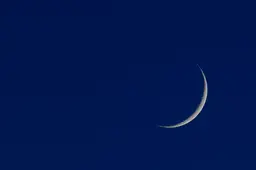
 New Moon..Cameradate: Saturday, April 25, 2020 21:45. New Moon..Cameradate: Saturday, April 25, 2020 21:45. | AME_100066712_20200425TET_2814 CC-BY Tor Tjeransen.jpg |
 Hours of Star Rotation Night Sky - Desert Australia Hours of Star Rotation Night Sky - Desert Australia | AME_100108178_CREATION-0136 CC-BY Henry Stober.upsc.CR.webp |
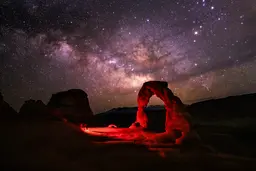 | Flickr geoliv_51405030915_1537455d60_o Head Lamp Love Under the Milky Way CC-BY-ND-ND Geoff Livingston.jpg |
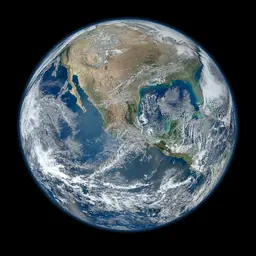 Most Amazing High Definition Image of Earth - Blue Marble 2012...A 'Blue Marble' image of the Earth taken from the VIIRS instrument aboard NASA's most recently launched Earth-observing satellite - Suomi NPP. This composite image uses a number of swaths of the Earth's surface taken on January 4, 2012. The NPP satellite was renamed 'Suomi NPP' on January 24, 2012 to honor the late Verner E. Suomi of the University of Wisconsin...Credit: NASA/NOAA/GSFC/Suomi NPP/VIIRS/Norman Kuring. Most Amazing High Definition Image of Earth - Blue Marble 2012...A 'Blue Marble' image of the Earth taken from the VIIRS instrument aboard NASA's most recently launched Earth-observing satellite - Suomi NPP. This composite image uses a number of swaths of the Earth's surface taken on January 4, 2012. The NPP satellite was renamed 'Suomi NPP' on January 24, 2012 to honor the late Verner E. Suomi of the University of Wisconsin...Credit: NASA/NOAA/GSFC/Suomi NPP/VIIRS/Norman Kuring. | Flickr gsfc_6760135001_14c59a1490_o CC-BY.jpg |
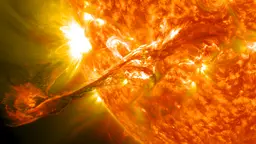 Magnificent CME Erupts on the Sun - August 31.Solar Flare.On August 31, 2012 a long filament of solar material that had been hovering in the sun's atmosphere, the corona, erupted out into space at 4:36 p.m. EDT. The coronal mass ejection, or CME, traveled at over 900 miles per second. The CME did not travel directly toward Earth, but did connect with Earth's magnetic environment, or magnetosphere, causing aurora to appear on the night of Monday, September 3.. .Pictured here is a lighten blended version of the 304 and 171 angstrom wavelengths. Cropped. Magnificent CME Erupts on the Sun - August 31.Solar Flare.On August 31, 2012 a long filament of solar material that had been hovering in the sun's atmosphere, the corona, erupted out into space at 4:36 p.m. EDT. The coronal mass ejection, or CME, traveled at over 900 miles per second. The CME did not travel directly toward Earth, but did connect with Earth's magnetic environment, or magnetosphere, causing aurora to appear on the night of Monday, September 3.. .Pictured here is a lighten blended version of the 304 and 171 angstrom wavelengths. Cropped. | Flickr gsfc_7931831962_b9d476c4a8_o CC-BY.jpg |
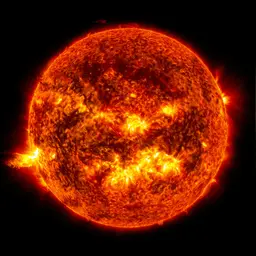 This image from June 20, 2013, at 11:15 p.m. EDT shows the bright light of a solar flare on the left side of the sun and an eruption of solar material shooting through the sun’s atmosphere, called a prominence eruption. Shortly thereafter, this same region of the sun sent a coronal mass ejection out into space. This image from June 20, 2013, at 11:15 p.m. EDT shows the bright light of a solar flare on the left side of the sun and an eruption of solar material shooting through the sun’s atmosphere, called a prominence eruption. Shortly thereafter, this same region of the sun sent a coronal mass ejection out into space. | Flickr gsfc_9103296900_6ea977cde0_o Sun Emits a Solstice CME CC-BY NASA.jpg |
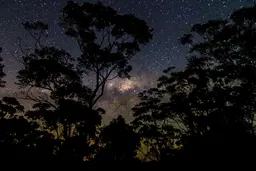 | Flickr kriis__xx_9830998285_1c9d0a70ee_o Milky Way and Airglow CC-BY-SA Christian Reusch.jpg |
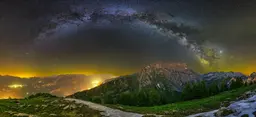 | Flickr lschlagenhauf_48139196133_ae06b4e139_o Nüenchamm milky way panorama CC-BY-ND Lukas Schlagenhauf.jpg |
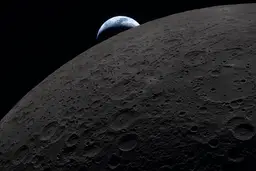 FD10_Lunar flyby Koch SN 1015 long lens FD10_Lunar flyby Koch SN 1015 long lens | Flickr nasa2explore_55208327975_1d1e5aa651_o Earthset on the Far Side Artemis II.CC-BY.NASA.jpg |
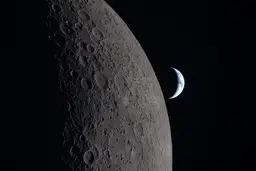 FD10_Lunar flyby Koch SN 1015 long lens FD10_Lunar flyby Koch SN 1015 long lens | Flickr nasa2explore_55208655682_9b9025ca38_o Crescent Earth Artemis II.CC-BY.NASA.jpg |
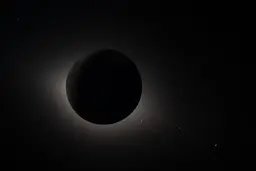 FD07_FD6 Lunar flyby imagry - D5 short lens 1022 Koch, wiseman, glover -wrong SN these are Z9 FD07_FD6 Lunar flyby imagry - D5 short lens 1022 Koch, wiseman, glover -wrong SN these are Z9 | Flickr nasa2explore_55208682757_882e4ffd5c_o Eclipse Artemis II.CC-BY.NASA.jpg |
 Landing Day for InSight.NASA's InSight spacecraft will complete its seven-month journey to Mars today. It will have cruised 301,223,981 miles (484,773,006 km) at a top speed of 6,200 mph (10,000 kph). Launched on May 5, InSight is the first spacecraft built to study Mars' deep interior. The landing will kick off a two-year mission that will help scientists understand the formation of the Red Planet and all rocky planets, including Earth. NASA's Jet Propulsion Laboratory manages the InSight mission for the agency's Science Mission Directorate. InSight is part of NASA's Discovery Program, managed by the Planetary Missions Program Office at Marshall Space Flight Center.. .This mosaic is composed of 102 Viking Orbiter images of Mars. The center of the scene (lat -8, long 78) shows the entire Valles Marineris canyon system, over 2000 kilometers long and up to 8 kilometers deep, extending form Noctis Labyrinthus, the arcuate system of graben to the west, to the chaotic terrain to the east.. .Image credit: NASA/JPL-Caltech Landing Day for InSight.NASA's InSight spacecraft will complete its seven-month journey to Mars today. It will have cruised 301,223,981 miles (484,773,006 km) at a top speed of 6,200 mph (10,000 kph). Launched on May 5, InSight is the first spacecraft built to study Mars' deep interior. The landing will kick off a two-year mission that will help scientists understand the formation of the Red Planet and all rocky planets, including Earth. NASA's Jet Propulsion Laboratory manages the InSight mission for the agency's Science Mission Directorate. InSight is part of NASA's Discovery Program, managed by the Planetary Missions Program Office at Marshall Space Flight Center.. .This mosaic is composed of 102 Viking Orbiter images of Mars. The center of the scene (lat -8, long 78) shows the entire Valles Marineris canyon system, over 2000 kilometers long and up to 8 kilometers deep, extending form Noctis Labyrinthus, the arcuate system of graben to the west, to the chaotic terrain to the east.. .Image credit: NASA/JPL-Caltech | Flickr nasamarshall_32190737718_8b09b06025_o Mars CC-BY-NC NASA.jpg |
 Curiosity’s Selfie at Mont Mercou.NASA’s Curiosity Mars rover used two different cameras to create this selfie in front of Mont Mercou, a rock outcrop that stands 20 feet (6 meters) tall. The panorama is made up of 60 images taken by the Mars Hand Lens Imager (MAHLI) on the rover’s robotic arm on March 26, 2021, the 3,070th Martian day, or sol, of the mission. These were combined with 11 images taken by the Mastcam on the mast, or “head,” of the rover on March 16, 2021, the 3,060th Martian day of the mission.. .The hole visible to the left of the rover is where its robotic drill sampled a rock nicknamed “Nontron.” The Curiosity team is nicknaming features in this part of Mars using names from the region around the village of Nontron in southwestern France.. .Curiosity was built by NASA’s Jet Propulsion Laboratory in Southern California. Caltech in Pasadena, California, manages JPL for NASA. JPL manages Curiosity's mission for NASA’s Science Mission Directorate in Washington. MAHLI was built by Malin Space Science Systems in San Diego.. .Image Credit: NASA/JPL-Caltech Curiosity’s Selfie at Mont Mercou.NASA’s Curiosity Mars rover used two different cameras to create this selfie in front of Mont Mercou, a rock outcrop that stands 20 feet (6 meters) tall. The panorama is made up of 60 images taken by the Mars Hand Lens Imager (MAHLI) on the rover’s robotic arm on March 26, 2021, the 3,070th Martian day, or sol, of the mission. These were combined with 11 images taken by the Mastcam on the mast, or “head,” of the rover on March 16, 2021, the 3,060th Martian day of the mission.. .The hole visible to the left of the rover is where its robotic drill sampled a rock nicknamed “Nontron.” The Curiosity team is nicknaming features in this part of Mars using names from the region around the village of Nontron in southwestern France.. .Curiosity was built by NASA’s Jet Propulsion Laboratory in Southern California. Caltech in Pasadena, California, manages JPL for NASA. JPL manages Curiosity's mission for NASA’s Science Mission Directorate in Washington. MAHLI was built by Malin Space Science Systems in San Diego.. .Image Credit: NASA/JPL-Caltech | Flickr nasamarshall_51440689915_4e81a84534_o Curiosity’s Selfie at Mont Mercou on Mars CC-BY NASA.jpg |
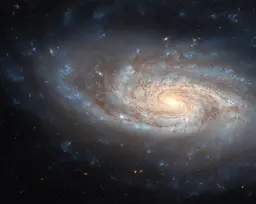 | Flickr nasamarshall_53958505266_015c889324_o Spiral Galaxy CC-BY-NC NASA.jpg |
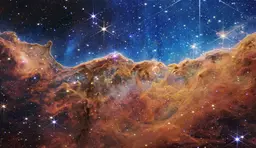 Carina Nebula (High resolution)..Image Description:.The image is divided horizontally by an undulating line between a cloudscape forming a nebula along the bottom portion and a comparatively clear upper portion. Speckled across both portions is a starfield, showing innumerable stars of many sizes. The smallest of these are small, distant, and faint points of light. The largest of these appear larger, closer, brighter, and more fully resolved with 8-point diffraction spikes. The upper portion of the image is blueish, and has wispy translucent cloud-like streaks rising from the nebula below. The orangish cloudy formation in the bottom half varies in density and ranges from translucent to opaque. The stars vary in color, the majority of which have a blue or orange hue. The cloud-like structure of the nebula contains ridges, peaks, and valleys – an appearance very similar to a mountain range. Three long diffraction spikes from the top right edge of the image suggest the presence of a large star just out of view.. .Credits: NASA, ESA, CSA, and STScI Carina Nebula (High resolution)..Image Description:.The image is divided horizontally by an undulating line between a cloudscape forming a nebula along the bottom portion and a comparatively clear upper portion. Speckled across both portions is a starfield, showing innumerable stars of many sizes. The smallest of these are small, distant, and faint points of light. The largest of these appear larger, closer, brighter, and more fully resolved with 8-point diffraction spikes. The upper portion of the image is blueish, and has wispy translucent cloud-like streaks rising from the nebula below. The orangish cloudy formation in the bottom half varies in density and ranges from translucent to opaque. The stars vary in color, the majority of which have a blue or orange hue. The cloud-like structure of the nebula contains ridges, peaks, and valleys – an appearance very similar to a mountain range. Three long diffraction spikes from the top right edge of the image suggest the presence of a large star just out of view.. .Credits: NASA, ESA, CSA, and STScI | Flickr nasawebbtelescope_52259221868_3d2963c1fe_o CC-BY NASA (smaller).webp |
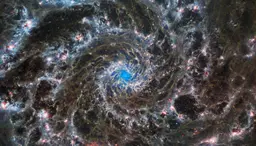 This image from the NASA/ESA/CSA James Webb Space Telescope shows the heart of M74, otherwise known as the Phantom Galaxy. Webb’s sharp vision has revealed delicate filaments of gas and dust in the grandiose spiral arms which wind outwards from the centre of this image. A lack of gas in the nuclear region also provides an unobscured view of the nuclear star cluster at the galaxy's centre. M74 is a particular class of spiral galaxy known as a ‘grand design spiral’, meaning that its spiral arms are prominent and well-defined, unlike the patchy and ragged structure seen in some spiral galaxies. The Phantom Galaxy is around 32 million light-years away from Earth in the constellation Pisces, and lies almost face-on to Earth. This, coupled with its well-defined spiral arms, makes it a favourite target for astronomers studying the origin and structure of galactic spirals. Webb gazed into M74 with its Mid-InfraRed Instrument (MIRI) in order to learn more about the earliest phases of star formation in the local Universe. These observations are part of a larger effort to chart 19 nearby star-forming galaxies in the infrared by the international PHANGS collaboration. Those galaxies have already been observed using the NASA/ESA Hubble Space Telescope and ground-based observatories. The addition of crystal-clear Webb observations at longer wavelengths will allow astronomers to pinpoint star-forming regions in the galaxies, accurately measure the masses and ages of star clusters, and gain insights into the nature of the small grains of dust drifting in interstellar space.Hubble observations of M74 have revealed particularly bright areas of star formation known as HII regions. Hubble’s sharp vision at ultraviolet and visible wavelengths complements Webb’s unparalleled sensitivity at infrared wavelengths, as do observations from ground-based radio telescopes such as the Atacama Large Millimeter/submillimeter Array, ALMA. By combining data from telescopes operating across the electromagnetic spectrum, scientists can gain greater insight into astronomical objects than by using a single observatory — even one as powerful as Webb! MIRI was contributed by ESA and NASA, with the instrument designed and built by a consortium of nationally funded European Institutes (the MIRI European Consortium) in partnership with JPL and the University of Arizona. Links Pan of the Phantom Galaxy Image B Image C This image from the NASA/ESA/CSA James Webb Space Telescope shows the heart of M74, otherwise known as the Phantom Galaxy. Webb’s sharp vision has revealed delicate filaments of gas and dust in the grandiose spiral arms which wind outwards from the centre of this image. A lack of gas in the nuclear region also provides an unobscured view of the nuclear star cluster at the galaxy's centre. M74 is a particular class of spiral galaxy known as a ‘grand design spiral’, meaning that its spiral arms are prominent and well-defined, unlike the patchy and ragged structure seen in some spiral galaxies. The Phantom Galaxy is around 32 million light-years away from Earth in the constellation Pisces, and lies almost face-on to Earth. This, coupled with its well-defined spiral arms, makes it a favourite target for astronomers studying the origin and structure of galactic spirals. Webb gazed into M74 with its Mid-InfraRed Instrument (MIRI) in order to learn more about the earliest phases of star formation in the local Universe. These observations are part of a larger effort to chart 19 nearby star-forming galaxies in the infrared by the international PHANGS collaboration. Those galaxies have already been observed using the NASA/ESA Hubble Space Telescope and ground-based observatories. The addition of crystal-clear Webb observations at longer wavelengths will allow astronomers to pinpoint star-forming regions in the galaxies, accurately measure the masses and ages of star clusters, and gain insights into the nature of the small grains of dust drifting in interstellar space.Hubble observations of M74 have revealed particularly bright areas of star formation known as HII regions. Hubble’s sharp vision at ultraviolet and visible wavelengths complements Webb’s unparalleled sensitivity at infrared wavelengths, as do observations from ground-based radio telescopes such as the Atacama Large Millimeter/submillimeter Array, ALMA. By combining data from telescopes operating across the electromagnetic spectrum, scientists can gain greater insight into astronomical objects than by using a single observatory — even one as powerful as Webb! MIRI was contributed by ESA and NASA, with the instrument designed and built by a consortium of nationally funded European Institutes (the MIRI European Consortium) in partnership with JPL and the University of Arizona. Links Pan of the Phantom Galaxy Image B Image C | Flickr nasawebbtelescope_52324826014_10db2ac268_o CC-BY NASA.jpg |
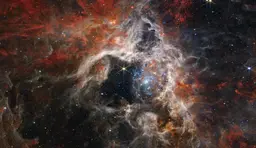 A Cosmic Tarantula, Caught by NASA’s Webb..Image description: A space image captured by the Webb telescope. Fluffy tan-colored nebula clouds, with rust-colored highlights, surround a black central area. Within that area, the focal point of the image is one large yellow star with eight long thin points. To the right of this star is a bright star cluster in an oval shape. The stars within the cluster look like tiny pale blue sparkles. The cluster is more densely packed at its core and scatters outward. Towards the bottom of the image, multiple arms appear to spiral out of a cloudy tan knob, resembling a spider or a squid structure. Other blue and yellow eight-pointed stars, as well as distant galaxies, are dotted throughout the image...Image Credit: NASA, ESA, CSA, STScI, Webb ERO Production Team... A Cosmic Tarantula, Caught by NASA’s Webb..Image description: A space image captured by the Webb telescope. Fluffy tan-colored nebula clouds, with rust-colored highlights, surround a black central area. Within that area, the focal point of the image is one large yellow star with eight long thin points. To the right of this star is a bright star cluster in an oval shape. The stars within the cluster look like tiny pale blue sparkles. The cluster is more densely packed at its core and scatters outward. Towards the bottom of the image, multiple arms appear to spiral out of a cloudy tan knob, resembling a spider or a squid structure. Other blue and yellow eight-pointed stars, as well as distant galaxies, are dotted throughout the image...Image Credit: NASA, ESA, CSA, STScI, Webb ERO Production Team... | Flickr nasawebbtelescope_52338778943_9704c200b4_o CC-BY NASA (smaller).webp |
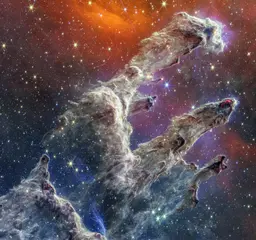 | Flickr nasawebbtelescope_52534406448_3909dd5a79_o CC-BY NASA.webp |
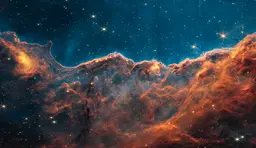 NASA’s Webb Unveils Young Stars in Early Stages of Formation..Image description: The image is divided horizontally by an undulating line between a cloudscape forming a nebula along the bottom portion and a comparatively clear upper portion. Speckled across both portions is a starfield. The upper portion of the image is blueish, and has wispy translucent cloud-like streaks rising from the nebula below. The orangish cloudy formation in the bottom half varies in density and ranges from translucent to opaque. The cloud-like structure of the nebula contains ridges, peaks, and valleys – an appearance very similar to a mountain range...Credits: NASA, ESA, CSA, STScI, Megan Reiter (Rice University), with image processing by Joseph DePasquale (STScI), Anton M. Koekemoer (STScI). NASA’s Webb Unveils Young Stars in Early Stages of Formation..Image description: The image is divided horizontally by an undulating line between a cloudscape forming a nebula along the bottom portion and a comparatively clear upper portion. Speckled across both portions is a starfield. The upper portion of the image is blueish, and has wispy translucent cloud-like streaks rising from the nebula below. The orangish cloudy formation in the bottom half varies in density and ranges from translucent to opaque. The cloud-like structure of the nebula contains ridges, peaks, and valleys – an appearance very similar to a mountain range...Credits: NASA, ESA, CSA, STScI, Megan Reiter (Rice University), with image processing by Joseph DePasquale (STScI), Anton M. Koekemoer (STScI). | Flickr nasawebbtelescope_52565304936_b7f9913fea_o CC-BY NASA.webp |
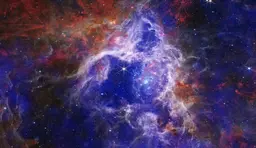 The Enduring Stellar Lifecycle in 30 Doradus (Composite: Infrared + X-ray)..Image description: Composite image of the Tarantula Nebula: Royal blue and purple gas clouds interact with red and orange gas clouds, as specks of light and large gleaming stars peek through. The blue and purple patches represent X-ray data from Chandra. The most striking blue cloud is shaped like an upward pointing triangle at the center. Wispy white clouds outline this blue triangle. Inside this frame is a gleaming star with six long, thin spikes. Beside it is a cluster of smaller bright blue specks showing young stars in the nebula. Darker X-ray clouds can be found near the right and left edges of the image. The red and orange gas clouds, which look like roiling fire, represent infrared data from Webb...Image credit: X-ray: NASA/CXC/Penn State Univ./L. Townsley et al.; IR: NASA/ESA/CSA/STScI/JWST ERO Production Team.. The Enduring Stellar Lifecycle in 30 Doradus (Composite: Infrared + X-ray)..Image description: Composite image of the Tarantula Nebula: Royal blue and purple gas clouds interact with red and orange gas clouds, as specks of light and large gleaming stars peek through. The blue and purple patches represent X-ray data from Chandra. The most striking blue cloud is shaped like an upward pointing triangle at the center. Wispy white clouds outline this blue triangle. Inside this frame is a gleaming star with six long, thin spikes. Beside it is a cluster of smaller bright blue specks showing young stars in the nebula. Darker X-ray clouds can be found near the right and left edges of the image. The red and orange gas clouds, which look like roiling fire, represent infrared data from Webb...Image credit: X-ray: NASA/CXC/Penn State Univ./L. Townsley et al.; IR: NASA/ESA/CSA/STScI/JWST ERO Production Team.. | Flickr nasawebbtelescope_52633392046_a874a336ea_o CC-BY NASA.jpg |
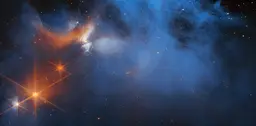 Webb Unveils Dark Side of Pre-stellar Ice Chemistry..Image description: A Webb image of the central region of the Chamaeleon I dark molecular cloud, which resides 630 light-years away. This image primarily shows blue smoky wisps on a dark background. The left top side additionally features orange and white wisps. Just below them are four bright points of light. Three are orange and one is a mix of white and orange. Each of these points have Webb’s signature 8-point diffraction spikes emanating around them in long, thick orange lines, so that they look like huge snowflakes. Scattered throughout the image are distant stars or galaxies in shades of red, orange and blue, seen as tiny blobs...Image Credit: NASA, ESA, CSA, and M. Zamani (ESA). Science: M. K. McClure (Leiden Observatory), F. Sun (Steward Observatory), Z. Smith (Open University), and the Ice Age ERS Team.. Webb Unveils Dark Side of Pre-stellar Ice Chemistry..Image description: A Webb image of the central region of the Chamaeleon I dark molecular cloud, which resides 630 light-years away. This image primarily shows blue smoky wisps on a dark background. The left top side additionally features orange and white wisps. Just below them are four bright points of light. Three are orange and one is a mix of white and orange. Each of these points have Webb’s signature 8-point diffraction spikes emanating around them in long, thick orange lines, so that they look like huge snowflakes. Scattered throughout the image are distant stars or galaxies in shades of red, orange and blue, seen as tiny blobs...Image Credit: NASA, ESA, CSA, and M. Zamani (ESA). Science: M. K. McClure (Leiden Observatory), F. Sun (Steward Observatory), Z. Smith (Open University), and the Ice Age ERS Team.. | Flickr nasawebbtelescope_52638633506_cfc0083021_o CC-BY NASA.webp |
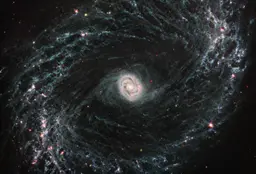 NASA’s Webb Reveals Intricate Networks of Gas and Dust in Nearby Galaxies..Image description:.A gray spiral galaxy with a bright white, circular core. Its spiral arms resemble spider web threads. Red dots are scattered throughout the black background...Credit: Science - NASA, ESA, CSA, and J. Lee (NOIRLab). Image processing - A. Pagan (STScI) NASA’s Webb Reveals Intricate Networks of Gas and Dust in Nearby Galaxies..Image description:.A gray spiral galaxy with a bright white, circular core. Its spiral arms resemble spider web threads. Red dots are scattered throughout the black background...Credit: Science - NASA, ESA, CSA, and J. Lee (NOIRLab). Image processing - A. Pagan (STScI) | Flickr nasawebbtelescope_52692663926_ed7fe9dc59_o CC-BY NASA.webp |
 NASA’s Webb Proves Galaxies Transformed the Early Universe..Image description: More than 20,000 tiny galaxies appear across the black background of space. The galaxy colors vary. Some of the smallest galaxies are shades of orange and pink. Most galaxies are so distant they appear as single points of light. Slightly larger, fuzzier galaxies appear whiter. Some have distinct spiral arms. In front of the galaxies are several foreground stars, though none appear larger than the largest galaxies. The foreground stars are scattered around the image, appear blue and have eight prominent diffraction spikes. At the center is a pink object with six diffraction spikes. This is quasar J0100+2802. It appears slightly smaller than the blue foreground stars...Credit: NASA, ESA, CSA, Simon Lilly (ETH Zurich), Daichi Kashino (Nagoya University), Jorryt Matthee (ETH Zurich), Christina Eilers (MIT), Rob Simcoe (MIT), Rongmon Bordoloi (North Carolina State University), Ruari Mackenzie (ETH Zurich). Image processing: Alyssa Pagan (STScI), Ruari Mackenzie (ETH Zurich). NASA’s Webb Proves Galaxies Transformed the Early Universe..Image description: More than 20,000 tiny galaxies appear across the black background of space. The galaxy colors vary. Some of the smallest galaxies are shades of orange and pink. Most galaxies are so distant they appear as single points of light. Slightly larger, fuzzier galaxies appear whiter. Some have distinct spiral arms. In front of the galaxies are several foreground stars, though none appear larger than the largest galaxies. The foreground stars are scattered around the image, appear blue and have eight prominent diffraction spikes. At the center is a pink object with six diffraction spikes. This is quasar J0100+2802. It appears slightly smaller than the blue foreground stars...Credit: NASA, ESA, CSA, Simon Lilly (ETH Zurich), Daichi Kashino (Nagoya University), Jorryt Matthee (ETH Zurich), Christina Eilers (MIT), Rob Simcoe (MIT), Rongmon Bordoloi (North Carolina State University), Ruari Mackenzie (ETH Zurich). Image processing: Alyssa Pagan (STScI), Ruari Mackenzie (ETH Zurich). | Flickr nasawebbtelescope_52969542198_4589cb1ebf_o CC-BY NASA.webp |
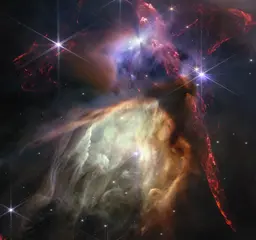 Webb Celebrates First Year of Science With Close-up on Birth of Sun-like Stars..Image description: Red dual opposing jets coming from young stars fill the darker top half of the image. At bottom center is a glowing pale yellow, cave-like structure, its top tilted toward two o’clock, with a bright star at its center. The dust of the cave structure becomes wispy toward eight o’clock. Above the arched top of the dust cave, 3 groupings of stars with diffraction spikes are arranged. A dark cloud sits at the top of the arch of the glowing dust cave, with one streamer curling down the right-hand side. The dark shadow of the cloud appears pinched in the center, with light emerging in a triangle shape above and below the pinch, revealing the presence of a star inside the cloud. The largest jets of red material emanate from within this dark cloud, thick and displaying structure like the rough face of a cliff, glowing brighter at the edges. At top center, a star displays another, larger pinched dark shadow, this time vertically. To the left of this star is a more wispy, indistinct region...Credit: NASA, ESA, CSA, STScI, Klaus Pontoppidan (STScI), Image Processing: Alyssa Pagan (STScI). Webb Celebrates First Year of Science With Close-up on Birth of Sun-like Stars..Image description: Red dual opposing jets coming from young stars fill the darker top half of the image. At bottom center is a glowing pale yellow, cave-like structure, its top tilted toward two o’clock, with a bright star at its center. The dust of the cave structure becomes wispy toward eight o’clock. Above the arched top of the dust cave, 3 groupings of stars with diffraction spikes are arranged. A dark cloud sits at the top of the arch of the glowing dust cave, with one streamer curling down the right-hand side. The dark shadow of the cloud appears pinched in the center, with light emerging in a triangle shape above and below the pinch, revealing the presence of a star inside the cloud. The largest jets of red material emanate from within this dark cloud, thick and displaying structure like the rough face of a cliff, glowing brighter at the edges. At top center, a star displays another, larger pinched dark shadow, this time vertically. To the left of this star is a more wispy, indistinct region...Credit: NASA, ESA, CSA, STScI, Klaus Pontoppidan (STScI), Image Processing: Alyssa Pagan (STScI). | Flickr nasawebbtelescope_53040527259_5682c6bcf0_o CC-BY NASA (smaller).webp |
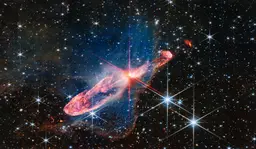 Webb Snaps Highly Detailed Infrared Image of Actively Forming Stars..Image description: At the center of the image is a horizontal orange cloud known as Herbig-Haro 46/47 that is uneven with rounded ends, and tilted from bottom left to top right. In the middle of this cloud is a yellow-white blob with 8 reddish pink diffraction spikes piercing through it. The left lobe of the cloud is thicker. Just off the edge is a tiny red arc that curves in the opposite direction. The right lobe is thinner, and ends in a smaller orange semi-circle that has a faint purple outline. Just off the edge of this lobe is a slightly smaller orange sponge-like blob. A delicate, semi-transparent blue cloud known as a nebula drifts toward the top of the image and peters out toward the left of the frame. Toward the right and bottom, the nebula ends in a soft ridge set off in a translucent orange. The background is filled with stars and galaxies. Two foreground stars with blue diffraction spikes, seen in the bottom right corner, are especially prominent...Credit: NASA, ESA, CSA. Image Processing: Joseph DePasquale (STScI). Webb Snaps Highly Detailed Infrared Image of Actively Forming Stars..Image description: At the center of the image is a horizontal orange cloud known as Herbig-Haro 46/47 that is uneven with rounded ends, and tilted from bottom left to top right. In the middle of this cloud is a yellow-white blob with 8 reddish pink diffraction spikes piercing through it. The left lobe of the cloud is thicker. Just off the edge is a tiny red arc that curves in the opposite direction. The right lobe is thinner, and ends in a smaller orange semi-circle that has a faint purple outline. Just off the edge of this lobe is a slightly smaller orange sponge-like blob. A delicate, semi-transparent blue cloud known as a nebula drifts toward the top of the image and peters out toward the left of the frame. Toward the right and bottom, the nebula ends in a soft ridge set off in a translucent orange. The background is filled with stars and galaxies. Two foreground stars with blue diffraction spikes, seen in the bottom right corner, are especially prominent...Credit: NASA, ESA, CSA. Image Processing: Joseph DePasquale (STScI). | Flickr nasawebbtelescope_53072881464_4275f02ec5_o CC-BY NASA (smaller).webp |
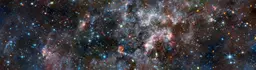 This image shows the irregular galaxy NGC 6822, as observed by the Mid-InfraRed Instrument (MIRI) mounted on the NASA/ESA/CSA James Webb Space Telescope. MIRI probes the mid-infrared, which in this case makes it perfectly suited to observe the dense regions of gas that suffuse this galaxy. At mid-infrared wavelengths the emission of light by galactic dust is prominent, obscuring the galaxy’s stars which themselves are faint at these longer wavelengths. Brilliant blue gas indicates light emitted by organic compounds called polycyclic aromatic hydrocarbons, which play a critical role in the formation of stars and planets. Cyan marks cooler patches of dust, while warmer dust is more orange. Distant galaxies far beyond NGC 6822 are displayed in orange. The few galaxies that are relatively closer, meanwhile, are marked in green by their own light-emitting dust, which MIRI can pick out. Bright red and magenta colours indicate active areas of star formation in the galaxy. With so many stars, supernova explosions are routine, and an amazing example of a supernova remnant is visible in this image: a red ring just below the centre. [Image Description: A dark field covered by many layers of billowing clouds, made of gas and dust, spread out in complex patterns. In the centre the clouds are dense and glowing; out towards the edges, they become dark and faint. Bright galaxies with various shapes and sizes shine through the clouds. Many bright stars with visible diffraction spikes are spread throughout the image.] Links Slider tool: NGC6822 (NIRCam and MIRI images) NGC 6822 (NIRCam+MIRI image) This image shows the irregular galaxy NGC 6822, as observed by the Mid-InfraRed Instrument (MIRI) mounted on the NASA/ESA/CSA James Webb Space Telescope. MIRI probes the mid-infrared, which in this case makes it perfectly suited to observe the dense regions of gas that suffuse this galaxy. At mid-infrared wavelengths the emission of light by galactic dust is prominent, obscuring the galaxy’s stars which themselves are faint at these longer wavelengths. Brilliant blue gas indicates light emitted by organic compounds called polycyclic aromatic hydrocarbons, which play a critical role in the formation of stars and planets. Cyan marks cooler patches of dust, while warmer dust is more orange. Distant galaxies far beyond NGC 6822 are displayed in orange. The few galaxies that are relatively closer, meanwhile, are marked in green by their own light-emitting dust, which MIRI can pick out. Bright red and magenta colours indicate active areas of star formation in the galaxy. With so many stars, supernova explosions are routine, and an amazing example of a supernova remnant is visible in this image: a red ring just below the centre. [Image Description: A dark field covered by many layers of billowing clouds, made of gas and dust, spread out in complex patterns. In the centre the clouds are dense and glowing; out towards the edges, they become dark and faint. Bright galaxies with various shapes and sizes shine through the clouds. Many bright stars with visible diffraction spikes are spread throughout the image.] Links Slider tool: NGC6822 (NIRCam and MIRI images) NGC 6822 (NIRCam+MIRI image) | Flickr nasawebbtelescope_53084246454_03ddb5cf83_o CC-BY NASA.jpg |
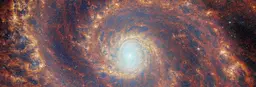 A FEAST for the eyes (M51/Whirlpool Galaxy)..Seen here is a composite image of galaxy M51 (also known as NGC 5194 also known as the Whirlpool) using both MIRI (Mid-Infrared Instrument) and NIRCam (Near Infrared Camera) data from the Webb telescope. The gravity of M51's neighbor, the dwarf galaxy NGC 5195, is thought to be partially responsible for those prominent and distinct spiral arms!..Image description: Composite image combining data from Webb's MIRI and NIRCam instruments. A large spiral galaxy takes up the entirety of the image. The core is mostly bright white, but there are also swirling, detailed structures that resemble water circling a drain. There is white and pale blue light that emanates from stars and dust at the core’s center, but it is tightly limited to the core. The rings feature colors of deep red and orange and highlight filaments of dust around cavernous black bubbles...Credit: ESA/Webb, NASA & CSA, A. Adamo and the FEAST JWST team.. A FEAST for the eyes (M51/Whirlpool Galaxy)..Seen here is a composite image of galaxy M51 (also known as NGC 5194 also known as the Whirlpool) using both MIRI (Mid-Infrared Instrument) and NIRCam (Near Infrared Camera) data from the Webb telescope. The gravity of M51's neighbor, the dwarf galaxy NGC 5195, is thought to be partially responsible for those prominent and distinct spiral arms!..Image description: Composite image combining data from Webb's MIRI and NIRCam instruments. A large spiral galaxy takes up the entirety of the image. The core is mostly bright white, but there are also swirling, detailed structures that resemble water circling a drain. There is white and pale blue light that emanates from stars and dust at the core’s center, but it is tightly limited to the core. The rings feature colors of deep red and orange and highlight filaments of dust around cavernous black bubbles...Credit: ESA/Webb, NASA & CSA, A. Adamo and the FEAST JWST team.. | Flickr nasawebbtelescope_53151475103_4f2bfa20dc_o CC-BY NASA.jpg |
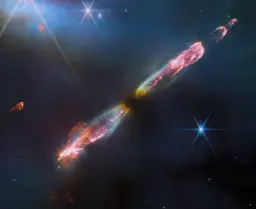 NASA's Webb Snaps Supersonic Outflow of Young Star..Image description: At the center is a thin horizontal pinkish cloud known as Herbig-Haro 211 that is uneven with rounded ends, and tilted from bottom left to top right. It takes up about two-thirds of the length of this angle, but is thinner and longer at the opposite angle. At its center is a dark spot. On either side of the dark spot, there are orangish yellow wisps that extend to light blue wisps. Within the center of those clouds, a pink fluffy streak runs through each lobe. At the ends of each lobe, pink becomes the dominant color. The lobe to the left is fatter. The right lobe is thinner, and ends in a smaller pink semi-circle. Just off the edge of this lobe is a slightly smaller pink semicircle, then a pink sponge-like blog. The background contains several bright stars, each with eight diffraction spikes extending out from the central bright point...Credit: ESA/Webb, NASA, CSA, T. Ray (Dublin). NASA's Webb Snaps Supersonic Outflow of Young Star..Image description: At the center is a thin horizontal pinkish cloud known as Herbig-Haro 211 that is uneven with rounded ends, and tilted from bottom left to top right. It takes up about two-thirds of the length of this angle, but is thinner and longer at the opposite angle. At its center is a dark spot. On either side of the dark spot, there are orangish yellow wisps that extend to light blue wisps. Within the center of those clouds, a pink fluffy streak runs through each lobe. At the ends of each lobe, pink becomes the dominant color. The lobe to the left is fatter. The right lobe is thinner, and ends in a smaller pink semi-circle. Just off the edge of this lobe is a slightly smaller pink semicircle, then a pink sponge-like blog. The background contains several bright stars, each with eight diffraction spikes extending out from the central bright point...Credit: ESA/Webb, NASA, CSA, T. Ray (Dublin). | Flickr nasawebbtelescope_53186159982_b8c76b0a07_o CC-BY NASA.webp |
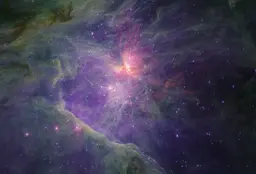 Long-wavelength NIRCam Orion mosaic in ESASky..Image description: An image of a young star-forming region filled with with wispy purple, green, and red nebulosity. The purple ionised gas is seen mostly towards the centre, with browns, greens, and reds behind, while the periphery is mostly bright green and darker brown to the left. There is a large spray of yellow, orange, red, and purple towards the top centre, and the nebula fades to near black to the right. There are thousands of stars sprinkled across the field, concentrated towards the centre, but they generally appear fainter at longer wavelengths, with some exceptions. The brightest sources in the field have extensive diffraction spikes characteristic of Webb...Image Credits: Image: NASA, ESA, CSA / Science leads and image processing: M. McCaughrean, S. Pearson, CC BY-SA 3.0 IGO. Long-wavelength NIRCam Orion mosaic in ESASky..Image description: An image of a young star-forming region filled with with wispy purple, green, and red nebulosity. The purple ionised gas is seen mostly towards the centre, with browns, greens, and reds behind, while the periphery is mostly bright green and darker brown to the left. There is a large spray of yellow, orange, red, and purple towards the top centre, and the nebula fades to near black to the right. There are thousands of stars sprinkled across the field, concentrated towards the centre, but they generally appear fainter at longer wavelengths, with some exceptions. The brightest sources in the field have extensive diffraction spikes characteristic of Webb...Image Credits: Image: NASA, ESA, CSA / Science leads and image processing: M. McCaughrean, S. Pearson, CC BY-SA 3.0 IGO. | Flickr nasawebbtelescope_53230009083_e2e7649f1f_o CC-BY NASA.webp |
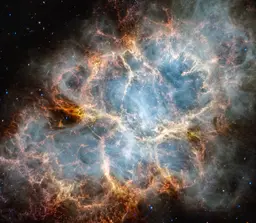 | Flickr nasawebbtelescope_53297865145_e3db450a1b_o Crab Nebula CC-BY NASA.webp |
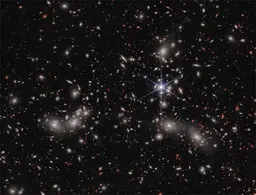 Pandora Cluster (NIRCam Image).Astronomers found the most distant black hole ever detected in X-rays (in a galaxy dubbed UHZ1) using the Chandra and Webb space telescopes. X-ray emission is a telltale signature of a growing supermassive black hole. This result may explain how some of the first supermassive black holes in the universe formed. This image is the infrared image from Webb only, and shows the galaxy cluster Abell 2744 that UHZ1 is located behind. For the composite Chandra/Webb image, see the feature: chandra.si.edu/photo/2023/uhz1/. .Credit: X-ray: NASA/CXC/SAO/Ákos Bogdán; Infrared: NASA/ESA/CSA/STScI; Image Processing: NASA/CXC/SAO/L. Frattare & K. Arcand. .Image description: The main image of this release features a glimpse of a black hole in an early stage of its development, just 470 million years after the Big Bang. Pandora Cluster (NIRCam Image).Astronomers found the most distant black hole ever detected in X-rays (in a galaxy dubbed UHZ1) using the Chandra and Webb space telescopes. X-ray emission is a telltale signature of a growing supermassive black hole. This result may explain how some of the first supermassive black holes in the universe formed. This image is the infrared image from Webb only, and shows the galaxy cluster Abell 2744 that UHZ1 is located behind. For the composite Chandra/Webb image, see the feature: chandra.si.edu/photo/2023/uhz1/. .Credit: X-ray: NASA/CXC/SAO/Ákos Bogdán; Infrared: NASA/ESA/CSA/STScI; Image Processing: NASA/CXC/SAO/L. Frattare & K. Arcand. .Image description: The main image of this release features a glimpse of a black hole in an early stage of its development, just 470 million years after the Big Bang. | Flickr nasawebbtelescope_53314473249_6a9dbfdfe8_o CC-BY NASA.jpg |
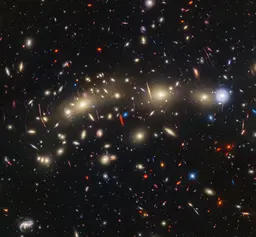 NASA’s Webb, Hubble Combine to Create Most Colorful View of Universe..This image:.This panchromatic view of galaxy cluster MACS0416 was created by combining infrared observations from NASA’s James Webb Space Telescope with visible-light data from NASA’s Hubble Space Telescope. The resulting wavelength coverage, from 0.4 to 5 microns, reveals a vivid landscape of galaxies whose colors give clues to galaxy distances: The bluest galaxies are relatively nearby and often show intense star formation, as best detected by Hubble, while the redder galaxies tend to be more distant, or else contain copious amount of dust, as detected by Webb. The image reveals a wealth of details that are only possible to capture by combining the power of both space telescopes. In this image, blue represents data at wavelengths of 0.435 and 0.606 microns (Hubble filters F435W and F606W); cyan is 0.814, 0.9, and 1.05 microns (Hubble filters F814W, and F105W and Webb filter F090W); green is 1.15, 1.25, 1.4, 1.5, and 1.6 microns (Hubble filters F125W, F140W, and F160W, and Webb filters F115W and F150W); yellow is 2.00 and 2.77 microns (Webb filters F200W, and F277W); orange is 3.56 microns (Webb filter F356W); and red represents data at 4.1 and 4.44 microns (Webb filters F410M and F444W)..NASA, ESA, CSA, STScI, J. Diego (Instituto de Física de Cantabria, Spain), J. D’Silva (U. Western Australia), A. Koekemoer (STScI), J. Summers & R. Windhorst (ASU), and H. Yan (U. Missouri).. . .[Image description: A field of galaxies on the black background of space. In the middle, stretching from left to right, is a collection of dozens of yellowish spiral and elliptical galaxies that form a foreground galaxy cluster. They form a rough, flat line along the center. Among them are distorted linear features, which mostly appear to follow invisible concentric circles curving around the center of the image. The linear features are created when the light of a background galaxy is bent and magnified through gravitational lensing. At center left, a particularly prominent example stretches vertically about three times the length of a nearby galaxy. A variety of brightly colored, red and blue galaxies of various shapes are scattered across the image, making it feel densely populated. Near the center are two tiny galaxies compared to the galaxy cluster: a very red edge-on spiral and a very blue face-on spiral, which provide a striking color contrast.].. NASA’s Webb, Hubble Combine to Create Most Colorful View of Universe..This image:.This panchromatic view of galaxy cluster MACS0416 was created by combining infrared observations from NASA’s James Webb Space Telescope with visible-light data from NASA’s Hubble Space Telescope. The resulting wavelength coverage, from 0.4 to 5 microns, reveals a vivid landscape of galaxies whose colors give clues to galaxy distances: The bluest galaxies are relatively nearby and often show intense star formation, as best detected by Hubble, while the redder galaxies tend to be more distant, or else contain copious amount of dust, as detected by Webb. The image reveals a wealth of details that are only possible to capture by combining the power of both space telescopes. In this image, blue represents data at wavelengths of 0.435 and 0.606 microns (Hubble filters F435W and F606W); cyan is 0.814, 0.9, and 1.05 microns (Hubble filters F814W, and F105W and Webb filter F090W); green is 1.15, 1.25, 1.4, 1.5, and 1.6 microns (Hubble filters F125W, F140W, and F160W, and Webb filters F115W and F150W); yellow is 2.00 and 2.77 microns (Webb filters F200W, and F277W); orange is 3.56 microns (Webb filter F356W); and red represents data at 4.1 and 4.44 microns (Webb filters F410M and F444W)..NASA, ESA, CSA, STScI, J. Diego (Instituto de Física de Cantabria, Spain), J. D’Silva (U. Western Australia), A. Koekemoer (STScI), J. Summers & R. Windhorst (ASU), and H. Yan (U. Missouri).. . .[Image description: A field of galaxies on the black background of space. In the middle, stretching from left to right, is a collection of dozens of yellowish spiral and elliptical galaxies that form a foreground galaxy cluster. They form a rough, flat line along the center. Among them are distorted linear features, which mostly appear to follow invisible concentric circles curving around the center of the image. The linear features are created when the light of a background galaxy is bent and magnified through gravitational lensing. At center left, a particularly prominent example stretches vertically about three times the length of a nearby galaxy. A variety of brightly colored, red and blue galaxies of various shapes are scattered across the image, making it feel densely populated. Near the center are two tiny galaxies compared to the galaxy cluster: a very red edge-on spiral and a very blue face-on spiral, which provide a striking color contrast.].. | Flickr nasawebbtelescope_53320910661_0567d04f04_o CC-BY NASA.webp |
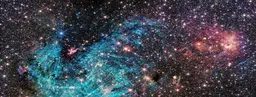 NASA's Webb Reveals New Features in Heart of Milky Way (NIRCAM image)..Credit: NASA, ESA, CSA, STScI, Samuel Crowe (UVA)..This image shows a field crowded with stars. A large, bright cyan-colored area surrounds the lower portion of a funnel-shaped region of space that is wider at the top edge of the image and then narrows. This funnel-shaped region appears darker than its surroundings. Toward the narrow end of this dark region a small clump of red and white appears to shoot out streamers upward and left. The cyan-colored area has needle-like structures and becomes more diffuse towards the right. The right side is dominated by clouds of orange and red, with a purple haze. NASA's Webb Reveals New Features in Heart of Milky Way (NIRCAM image)..Credit: NASA, ESA, CSA, STScI, Samuel Crowe (UVA)..This image shows a field crowded with stars. A large, bright cyan-colored area surrounds the lower portion of a funnel-shaped region of space that is wider at the top edge of the image and then narrows. This funnel-shaped region appears darker than its surroundings. Toward the narrow end of this dark region a small clump of red and white appears to shoot out streamers upward and left. The cyan-colored area has needle-like structures and becomes more diffuse towards the right. The right side is dominated by clouds of orange and red, with a purple haze. | Flickr nasawebbtelescope_53344798019_fb5bd5b699_o CC-BY NASA.webp |
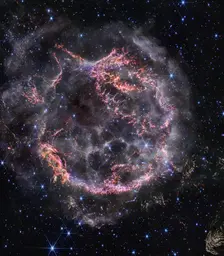 NASA's Webb Stuns With New High-Definition Look at Exploded Star..Cassiopeia A, a round cloud of gas and dust with complex structure. The inner shell is made of bright pink and orange filaments studded with clumps and knots. Around the exterior of the inner shell, particularly at the upper right, there are curtains of wispy gas that look like campfire smoke. The white smoke-like material also appears to fill the cavity of the inner shell, featuring structures shaped like large bubbles. Around and within the nebula, there are various stars seen as points of blue and white light. Outside the nebula, there are also clumps of yellow dust, with a particularly large clump at the bottom right corner that appears to have very detailed striations...Credit: NASA, ESA, CSA, STScI, D. Milisavljevic (Purdue University), T. Temim (Princeton University), I. De Looze (Ghent University) NASA's Webb Stuns With New High-Definition Look at Exploded Star..Cassiopeia A, a round cloud of gas and dust with complex structure. The inner shell is made of bright pink and orange filaments studded with clumps and knots. Around the exterior of the inner shell, particularly at the upper right, there are curtains of wispy gas that look like campfire smoke. The white smoke-like material also appears to fill the cavity of the inner shell, featuring structures shaped like large bubbles. Around and within the nebula, there are various stars seen as points of blue and white light. Outside the nebula, there are also clumps of yellow dust, with a particularly large clump at the bottom right corner that appears to have very detailed striations...Credit: NASA, ESA, CSA, STScI, D. Milisavljevic (Purdue University), T. Temim (Princeton University), I. De Looze (Ghent University) | Flickr nasawebbtelescope_53389652123_d38edbe3d7_o CC-BY NASA (smaller).webp |
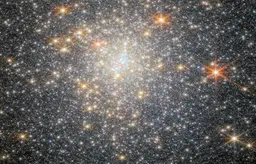 This new image from the NASA/ESA/CSA James Webb Space Telescope features NGC 6440, a globular cluster that resides roughly 28 000 light-years from Earth in the constellation Sagittarius. The object was first discovered by William Herschel in May of 1786. Globular clusters like NGC 6440 are roughly spherical, tightly packed, collections of old stars bound together by gravity. They can be found throughout galaxies, but often live on the outskirts. They hold hundreds of thousands to millions of stars that are on average about one light-year apart, but they can be as close together as the size of our Solar System. NGC 6440 is known to be a high-mass and metal-rich cluster that formed and is orbiting within the Galactic bulge, which is a dense, near-spherical region of old stars in the inner part of the Milky Way. This image was obtained with 2023 data from Webb’s Near-InfraRed Camera (NIRCam) as part of an observation programme to explore the stars in the cluster and to investigate details of the cluster’s pulsars. A pulsar is a highly magnetised, rotating neutron star that emits a beam of electromagnetic radiation from their magnetic poles. To us, that beam appears as a short burst or pulse as the star rotates. Pulsars spin extremely fast. Astronomers have clocked the fastest pulsars at more than 716 rotations per second, but a pulsar could theoretically rotate as fast as 1500 rotations per second before slowly losing energy or breaking apart. The new data obtained by the science team indicate the first evidence from Webb observations of abundance variations of helium and oxygen in stars in a globular cluster. These results open the window for future, in-depth investigations of other clusters in the Galactic bulge, which were previously infeasible with other telescope facilities given the significant crowding of stars in the cluster and the strong reddening caused by interstellar dust between the cluster and Earth. [Image Description: A spherical collection of stars which fills the whole view. The cluster is dominated by a concentrated group of bright white stars at the centre, with several large yellow stars scattered throughout the image. Many of the stars have visible diffraction spikes. The background is black.] Links Star studded cluster (NIRCam image wide-field view) Slider tool: Hubble and Webb’s views of NGC 6440 Pan video: NGC 6440 Transition video: Hubble and Webb’s views of NGC 6440 Science paper This new image from the NASA/ESA/CSA James Webb Space Telescope features NGC 6440, a globular cluster that resides roughly 28 000 light-years from Earth in the constellation Sagittarius. The object was first discovered by William Herschel in May of 1786. Globular clusters like NGC 6440 are roughly spherical, tightly packed, collections of old stars bound together by gravity. They can be found throughout galaxies, but often live on the outskirts. They hold hundreds of thousands to millions of stars that are on average about one light-year apart, but they can be as close together as the size of our Solar System. NGC 6440 is known to be a high-mass and metal-rich cluster that formed and is orbiting within the Galactic bulge, which is a dense, near-spherical region of old stars in the inner part of the Milky Way. This image was obtained with 2023 data from Webb’s Near-InfraRed Camera (NIRCam) as part of an observation programme to explore the stars in the cluster and to investigate details of the cluster’s pulsars. A pulsar is a highly magnetised, rotating neutron star that emits a beam of electromagnetic radiation from their magnetic poles. To us, that beam appears as a short burst or pulse as the star rotates. Pulsars spin extremely fast. Astronomers have clocked the fastest pulsars at more than 716 rotations per second, but a pulsar could theoretically rotate as fast as 1500 rotations per second before slowly losing energy or breaking apart. The new data obtained by the science team indicate the first evidence from Webb observations of abundance variations of helium and oxygen in stars in a globular cluster. These results open the window for future, in-depth investigations of other clusters in the Galactic bulge, which were previously infeasible with other telescope facilities given the significant crowding of stars in the cluster and the strong reddening caused by interstellar dust between the cluster and Earth. [Image Description: A spherical collection of stars which fills the whole view. The cluster is dominated by a concentrated group of bright white stars at the centre, with several large yellow stars scattered throughout the image. Many of the stars have visible diffraction spikes. The background is black.] Links Star studded cluster (NIRCam image wide-field view) Slider tool: Hubble and Webb’s views of NGC 6440 Pan video: NGC 6440 Transition video: Hubble and Webb’s views of NGC 6440 Science paper | Flickr nasawebbtelescope_53691677609_79de4d06b0_o Star-Studded Cluster (NGC 6440) CC-BY NASA.jpg |
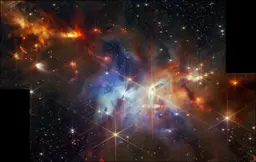 | Flickr nasawebbtelescope_53804051336_3a87b00dce_o CC-BY NASA.webp |
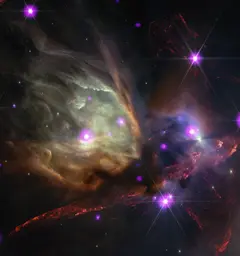 | Flickr nasawebbtelescope_53849910476_01c356b55b_o Rho Ophiuchi Composite CC-BY NASA.jpg |
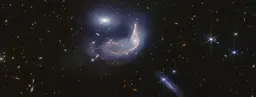 | Flickr nasawebbtelescope_53852285870_01497c017d_o Arp 142 CC-BY NASA.webp |
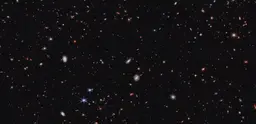 | Flickr nasawebbtelescope_53949426179_1e3cd55d2b_o Early Galaxies CC-BY NASA.webp |
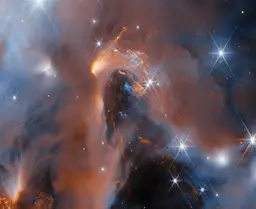 | Flickr nasawebbtelescope_53951942710_9389759151_o Peeking into Perseus (NGC 1333) CC-BY NASA.webp |
 | Flickr rod_waddington_47990146188_d4c3f682d0_o Ethiopia Sunset CC-BY-SA Rod Waddington.jpg |
 | Flickr trevor_dobson_inefekt69_32166780988_f66f417fec_o Diffused Milky Way CC-BY-NC-ND Trevor Dobson (scaled).webp |
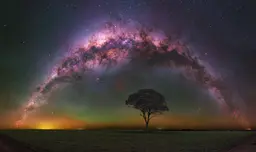 | Flickr trevor_dobson_inefekt69_53058944903_87e7d1471c_o Milky Way at Cadoux, Western Australia CC-BY-NC-ND Trevor Dobson (smaller).jpg |
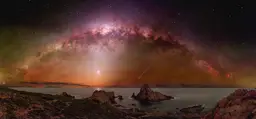 Milky Way & Comet A3 at Sugarloaf Rock, Western Australia..CC-BY-NC-ND Trevor Dobson.https://www.flickr.com/photos/trevor_dobson_inefekt69/54457512581/in/feed-23316939-1744874324-1-72157721760667417..Nikon d810a.50mm.ISO 3200.f/2.0.Foreground: 10 x 25 seconds.Sky: 50 x 25 seconds.H-Alpha: 8 x 60 seconds.iOptron SkyTracker. .This is a 68 shot panorama of the Milky Way and comet C/2023 A3 (Tsuchinshan–ATLAS) as they both set above Sugarloaf Rock, 3 hours south of Perth in Western Australia. Venus can be seen shining very brightly just to the right of Rho Ophiuchi, enveloped by the Zodiachal Light. The red parts of the sky are hydrogen alpha emitting regions, captured with a filter that isolates that part of the spectrum, the most prominent of which is to the right around Cygnus.. .Airglow was also quite strong, thanks to the fact we are at solar maximum which not only produces more active aurora but also airglow. The cloud on the horizon quickly caught up to us and put an early end to the night, but not before we did what we drove 2.5 hours to do, thankfully. Milky Way & Comet A3 at Sugarloaf Rock, Western Australia..CC-BY-NC-ND Trevor Dobson.https://www.flickr.com/photos/trevor_dobson_inefekt69/54457512581/in/feed-23316939-1744874324-1-72157721760667417..Nikon d810a.50mm.ISO 3200.f/2.0.Foreground: 10 x 25 seconds.Sky: 50 x 25 seconds.H-Alpha: 8 x 60 seconds.iOptron SkyTracker. .This is a 68 shot panorama of the Milky Way and comet C/2023 A3 (Tsuchinshan–ATLAS) as they both set above Sugarloaf Rock, 3 hours south of Perth in Western Australia. Venus can be seen shining very brightly just to the right of Rho Ophiuchi, enveloped by the Zodiachal Light. The red parts of the sky are hydrogen alpha emitting regions, captured with a filter that isolates that part of the spectrum, the most prominent of which is to the right around Cygnus.. .Airglow was also quite strong, thanks to the fact we are at solar maximum which not only produces more active aurora but also airglow. The cloud on the horizon quickly caught up to us and put an early end to the night, but not before we did what we drove 2.5 hours to do, thankfully. | Flickr trevor_dobson_inefekt69_54457512581_e9414c41f5_o Milky Way & Comet A3 at Sugarloaf Rock CC-BY-NC-ND Trevor Dobson.smaller.webp |
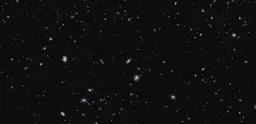 Galaxies from the James Webb Space Telescope, CEERS Survey crop. From https://esawebb.org/images/CEERS11/ Galaxies from the James Webb Space Telescope, CEERS Survey crop. From https://esawebb.org/images/CEERS11/ | Galaxies in Space CEERS Survey JWST.CC-BY.NASA-ESA.webp |
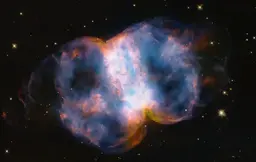 Hubble Celebrates 34th Anniversary with a Look at the Little Dumbbell Nebula..NASA Hubble Mission Team.Goddard Space Flight Center.APR 23, 2024.ARTICLE.In celebration of the 34th anniversary of the launch of NASA's legendary Hubble Space Telescope on April 24, astronomers took a snapshot of the Little Dumbbell Nebula (also known as Messier 76, M76, or NGC 650/651) located 3,400 light-years away in the northern circumpolar constellation Perseus. The photogenic nebula is a favorite target of amateur astronomers...From https://science.nasa.gov/missions/hubble/hubble-celebrates-34th-anniversary-with-little-dumbbell-nebula/ Hubble Celebrates 34th Anniversary with a Look at the Little Dumbbell Nebula..NASA Hubble Mission Team.Goddard Space Flight Center.APR 23, 2024.ARTICLE.In celebration of the 34th anniversary of the launch of NASA's legendary Hubble Space Telescope on April 24, astronomers took a snapshot of the Little Dumbbell Nebula (also known as Messier 76, M76, or NGC 650/651) located 3,400 light-years away in the northern circumpolar constellation Perseus. The photogenic nebula is a favorite target of amateur astronomers...From https://science.nasa.gov/missions/hubble/hubble-celebrates-34th-anniversary-with-little-dumbbell-nebula/ | hubble-34th-littledumbell-stsci-01htddqw1h508m7gww4eyfmh3h.webp |
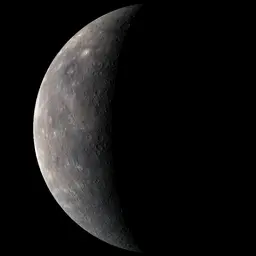 converted PNM file...Original Caption Released with Image:.As MESSENGER approached Mercury for the mission's third and final flyby of the Solar System's innermost planet, the WAC acquired images through all 11 of its narrow-band color filters. The 1000, 700, and 430 nanometer filters were combined in red, green, and blue to create this color image, the last close-up color view that will be acquired until MESSENGER goes into orbit around Mercury in March of 2011. Only 6% of Mercury's surface in this image had not been viewed previously by spacecraft, and most of the measurements made by MESSENGER's other instruments during this flyby were made prior to closest approach. The observations from MESSENGER's third flyby of Mercury nonetheless revealed fresh surprises. Check out the NASA Science Update Telecon held today for details about some of these new surprises..Date Acquired: September 29, 2009.Instrument: Wide Angle Camera (WAC) of the Mercury Dual Imaging System (MDIS).WAC Filter: 9, 1, 6 (1000, 700, and 430 nanometers).Resolution: 5 kilometers/pixel (3 miles/pixel).Scale: Mercury's diameter is 4880 kilometers (3030 miles).These images are from MESSENGER, a NASA Discovery mission to conduct the first orbital study of the innermost planet, Mercury. For information regarding the use of images, see the MESSENGER image use policy..Image Credit:.NASA/Johns Hopkins University Applied Physics Laboratory/Carnegie Institution of Washington..Image Addition Date:.2009-11-03. converted PNM file...Original Caption Released with Image:.As MESSENGER approached Mercury for the mission's third and final flyby of the Solar System's innermost planet, the WAC acquired images through all 11 of its narrow-band color filters. The 1000, 700, and 430 nanometer filters were combined in red, green, and blue to create this color image, the last close-up color view that will be acquired until MESSENGER goes into orbit around Mercury in March of 2011. Only 6% of Mercury's surface in this image had not been viewed previously by spacecraft, and most of the measurements made by MESSENGER's other instruments during this flyby were made prior to closest approach. The observations from MESSENGER's third flyby of Mercury nonetheless revealed fresh surprises. Check out the NASA Science Update Telecon held today for details about some of these new surprises..Date Acquired: September 29, 2009.Instrument: Wide Angle Camera (WAC) of the Mercury Dual Imaging System (MDIS).WAC Filter: 9, 1, 6 (1000, 700, and 430 nanometers).Resolution: 5 kilometers/pixel (3 miles/pixel).Scale: Mercury's diameter is 4880 kilometers (3030 miles).These images are from MESSENGER, a NASA Discovery mission to conduct the first orbital study of the innermost planet, Mercury. For information regarding the use of images, see the MESSENGER image use policy..Image Credit:.NASA/Johns Hopkins University Applied Physics Laboratory/Carnegie Institution of Washington..Image Addition Date:.2009-11-03. | PIA12365 Mercury Messenger Approach Sept 2009 PD NASA.webp |
 This was Cassini’s view from orbit around Saturn on Jan. 2, 2010. In this image, the rings on the night side of the planet have been brightened significantly to more clearly reveal their features. On the day side, the rings are illuminated both by direct sunlight, and by light reflected off Saturn’s cloud tops..This natural-color view is a composite of images taken in visible light with the Cassini spacecraft’s narrow-angle camera at a distance of approximately 1.4 million miles (2.3 million kilometers) from Saturn. This was Cassini’s view from orbit around Saturn on Jan. 2, 2010. In this image, the rings on the night side of the planet have been brightened significantly to more clearly reveal their features. On the day side, the rings are illuminated both by direct sunlight, and by light reflected off Saturn’s cloud tops..This natural-color view is a composite of images taken in visible light with the Cassini spacecraft’s narrow-angle camera at a distance of approximately 1.4 million miles (2.3 million kilometers) from Saturn. | PIA12567-full Saturn from Cassini Spacecraft.webp |
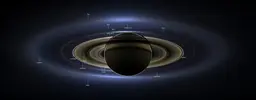
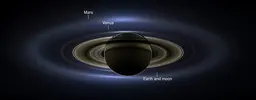 | PIA17172 Saturn and Earth from Cassini Spacecraft_fig2.jpg |
 | PIA17172 Saturn and Earth from Cassini Spacecraft_fig3.jpg |
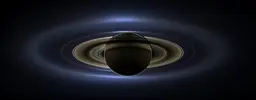 The Day the Earth Smiled..View of Earth through Saturn's Rings from Cassini Spacecraft...On July 19, 2013, in an event celebrated the world over, NASA's Cassini spacecraft slipped into Saturn's shadow and turned to image the planet, seven of its moons, its inner rings -- and, in the background, our home planet, Earth..With the sun's powerful and potentially damaging rays eclipsed by Saturn itself, Cassini's onboard cameras were able to take advantage of this unique viewing geometry. They acquired a panoramic mosaic of the Saturn system that allows scientists to see details in the rings and throughout the system as they are backlit by the sun. This mosaic is special as it marks the third time our home planet was imaged from the outer solar system; the second time it was imaged by Cassini from Saturn's orbit; and the first time ever that inhabitants of Earth were made aware in advance that their photo would be taken from such a great distance..With both Cassini's wide-angle and narrow-angle cameras aimed at Saturn, Cassini was able to capture 323 images in just over four hours. This final mosaic uses 141 of those wide-angle images. Images taken using the red, green and blue spectral filters of the wide-angle camera were combined and mosaicked together to create this natural-color view. A brightened version with contrast and color enhanced (Figure 1), a version with just the planets annotated (Figure 2), and an annotated version (Figure 3) are shown above..This image spans about 404,880 miles (651,591 kilometers) across.. The Day the Earth Smiled..View of Earth through Saturn's Rings from Cassini Spacecraft...On July 19, 2013, in an event celebrated the world over, NASA's Cassini spacecraft slipped into Saturn's shadow and turned to image the planet, seven of its moons, its inner rings -- and, in the background, our home planet, Earth..With the sun's powerful and potentially damaging rays eclipsed by Saturn itself, Cassini's onboard cameras were able to take advantage of this unique viewing geometry. They acquired a panoramic mosaic of the Saturn system that allows scientists to see details in the rings and throughout the system as they are backlit by the sun. This mosaic is special as it marks the third time our home planet was imaged from the outer solar system; the second time it was imaged by Cassini from Saturn's orbit; and the first time ever that inhabitants of Earth were made aware in advance that their photo would be taken from such a great distance..With both Cassini's wide-angle and narrow-angle cameras aimed at Saturn, Cassini was able to capture 323 images in just over four hours. This final mosaic uses 141 of those wide-angle images. Images taken using the red, green and blue spectral filters of the wide-angle camera were combined and mosaicked together to create this natural-color view. A brightened version with contrast and color enhanced (Figure 1), a version with just the planets annotated (Figure 2), and an annotated version (Figure 3) are shown above..This image spans about 404,880 miles (651,591 kilometers) across.. | PIA17172 Saturn and Earth from Cassini Spacecraft.webp |
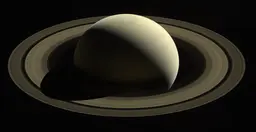 With this view, Cassini captured one of its last looks at Saturn and its main rings from a distance. The Saturn system has been Cassini's home for 13 years, but that journey is nearing its end..Cassini has been orbiting Saturn for nearly a half of a Saturnian year but that journey is nearing its end. This extended stay has permitted observations of the long-term variability of the planet, moons, rings, and magnetosphere, observations not possible from short, fly-by style missions..When the spacecraft arrived at Saturn in 2004, the planet's northern hemisphere, seen here at top, was in darkness, just beginning to emerge from winter (see Cassini's Holiday Greetings). Now at journey's end, the entire north pole is bathed in the continuous sunlight of summer..Images taken on Oct. 28, 2016 with the wide angle camera using red, green and blue spectral filters were combined to create this color view. This view looks toward the sunlit side of the rings from about 25 degrees above the ringplane..The view was acquired at a distance of approximately 870,000 miles (1.4 million kilometers) from Saturn. Image scale is 50 miles (80 kilometers) per pixel. With this view, Cassini captured one of its last looks at Saturn and its main rings from a distance. The Saturn system has been Cassini's home for 13 years, but that journey is nearing its end..Cassini has been orbiting Saturn for nearly a half of a Saturnian year but that journey is nearing its end. This extended stay has permitted observations of the long-term variability of the planet, moons, rings, and magnetosphere, observations not possible from short, fly-by style missions..When the spacecraft arrived at Saturn in 2004, the planet's northern hemisphere, seen here at top, was in darkness, just beginning to emerge from winter (see Cassini's Holiday Greetings). Now at journey's end, the entire north pole is bathed in the continuous sunlight of summer..Images taken on Oct. 28, 2016 with the wide angle camera using red, green and blue spectral filters were combined to create this color view. This view looks toward the sunlit side of the rings from about 25 degrees above the ringplane..The view was acquired at a distance of approximately 870,000 miles (1.4 million kilometers) from Saturn. Image scale is 50 miles (80 kilometers) per pixel. | PIA21345-full Saturn from Cassini Spacecraft.webp |
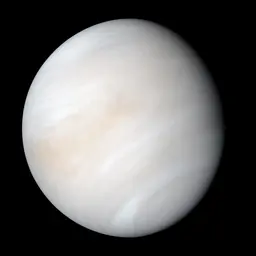 As it sped away from Venus, NASA's Mariner 10 spacecraft captured this seemingly peaceful view of a planet the size of Earth, wrapped in a dense, global cloud layer. But, contrary to its serene appearance, the clouded globe of Venus is a world of intense heat, crushing atmospheric pressure and clouds of corrosive acid..This newly processed image revisits the original data with modern image processing software. A contrast-enhanced version of this view, also provided here, makes features in the planet's thick cloud cover visible in greater detail..The clouds seen here are located about 40 miles (60 kilometers) above the planet's surface, at altitudes where Earth-like atmospheric pressures and temperatures exist. They are comprised of sulfuric acid particles, as opposed to water droplets or ice crystals, as on Earth. These cloud particles are mostly white in appearance; however, patches of red-tinted clouds also can be seen. This is due to the presence of a mysterious material that absorbs light at blue and ultraviolet wavelengths. Many chemicals have been suggested for this mystery component, from sulfur compounds to even biological materials, but a consensus has yet to be reached among researchers..The clouds of Venus whip around the planet at nearly over 200 miles per hour (100 meters per second), circling the globe in about four and a half days. That these hurricane-force winds cover nearly the entire planet is another unexplained mystery, especially given that the solid planet itself rotates at a very slow 4 mph (less than 2 meters per second) — much slower than Earth's rotation rate of about 1,000 mph (450 meters per second)..The winds and clouds also blow to the west, not to the east as on the Earth. This is because the planet itself rotates to the west, backward compared to Earth and most of the other planets. As the clouds travel westward, they also typically progress toward the poles; this can be seen in the Mariner 10 view as a curved spiral pattern at mid latitudes. Near the equator, instead of long streaks, areas of more clumpy, discrete clouds can be seen, indicating enhanced upwelling and cloud formation in the equatorial region, spurred on by the enhanced power of sunlight there..This view is a false color composite created by combining images taken using orange and ultraviolet spectral filters on the spacecraft's imaging camera. These were used for the red and blue channels of the color image, respectively, with the green channel synthesized by combining the other two images..Flying past Venus en route to the first-ever flyby of Mercury, Mariner 10 became the first spacecraft to use a gravity assist to change its flight path in order to reach another planet. The images used to create this view were acquired by Mariner 10 on Feb. 7 and 8, 1974, a couple of days after the spacecraft's closest approach to Venus on Feb. 5..Despite their many differences, comparisons between Earth and Venus are valuable for helping to understand their distinct climate histories. Nearly 50 years after this view was obtained, many fundamental questions about Venus remain unanswered. Did Venus have oceans long ago? How has its atmosphere evolved over time, and when did its runaway greenhouse effect begin? How does Venus lose its heat? How volcanically and tectonically active has Venus been over the last billion years?.This image was processed from archived Mariner 10 data by JPL engineer Kevin M. Gill..The Mariner 10 mission was managed by NASA's Jet Propulsion Laboratory. As it sped away from Venus, NASA's Mariner 10 spacecraft captured this seemingly peaceful view of a planet the size of Earth, wrapped in a dense, global cloud layer. But, contrary to its serene appearance, the clouded globe of Venus is a world of intense heat, crushing atmospheric pressure and clouds of corrosive acid..This newly processed image revisits the original data with modern image processing software. A contrast-enhanced version of this view, also provided here, makes features in the planet's thick cloud cover visible in greater detail..The clouds seen here are located about 40 miles (60 kilometers) above the planet's surface, at altitudes where Earth-like atmospheric pressures and temperatures exist. They are comprised of sulfuric acid particles, as opposed to water droplets or ice crystals, as on Earth. These cloud particles are mostly white in appearance; however, patches of red-tinted clouds also can be seen. This is due to the presence of a mysterious material that absorbs light at blue and ultraviolet wavelengths. Many chemicals have been suggested for this mystery component, from sulfur compounds to even biological materials, but a consensus has yet to be reached among researchers..The clouds of Venus whip around the planet at nearly over 200 miles per hour (100 meters per second), circling the globe in about four and a half days. That these hurricane-force winds cover nearly the entire planet is another unexplained mystery, especially given that the solid planet itself rotates at a very slow 4 mph (less than 2 meters per second) — much slower than Earth's rotation rate of about 1,000 mph (450 meters per second)..The winds and clouds also blow to the west, not to the east as on the Earth. This is because the planet itself rotates to the west, backward compared to Earth and most of the other planets. As the clouds travel westward, they also typically progress toward the poles; this can be seen in the Mariner 10 view as a curved spiral pattern at mid latitudes. Near the equator, instead of long streaks, areas of more clumpy, discrete clouds can be seen, indicating enhanced upwelling and cloud formation in the equatorial region, spurred on by the enhanced power of sunlight there..This view is a false color composite created by combining images taken using orange and ultraviolet spectral filters on the spacecraft's imaging camera. These were used for the red and blue channels of the color image, respectively, with the green channel synthesized by combining the other two images..Flying past Venus en route to the first-ever flyby of Mercury, Mariner 10 became the first spacecraft to use a gravity assist to change its flight path in order to reach another planet. The images used to create this view were acquired by Mariner 10 on Feb. 7 and 8, 1974, a couple of days after the spacecraft's closest approach to Venus on Feb. 5..Despite their many differences, comparisons between Earth and Venus are valuable for helping to understand their distinct climate histories. Nearly 50 years after this view was obtained, many fundamental questions about Venus remain unanswered. Did Venus have oceans long ago? How has its atmosphere evolved over time, and when did its runaway greenhouse effect begin? How does Venus lose its heat? How volcanically and tectonically active has Venus been over the last billion years?.This image was processed from archived Mariner 10 data by JPL engineer Kevin M. Gill..The Mariner 10 mission was managed by NASA's Jet Propulsion Laboratory. | PIA23791-A Venus from Mariner 10 Feb 1974 PD NASA.webp |
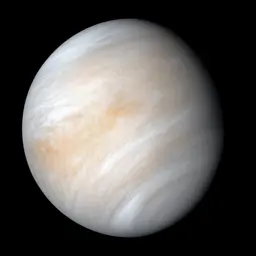 As it sped away from Venus, NASA's Mariner 10 spacecraft captured this seemingly peaceful view of a planet the size of Earth, wrapped in a dense, global cloud layer. But, contrary to its serene appearance, the clouded globe of Venus is a world of intense heat, crushing atmospheric pressure and clouds of corrosive acid..This newly processed image revisits the original data with modern image processing software. A contrast-enhanced version of this view, also provided here, makes features in the planet's thick cloud cover visible in greater detail..The clouds seen here are located about 40 miles (60 kilometers) above the planet's surface, at altitudes where Earth-like atmospheric pressures and temperatures exist. They are comprised of sulfuric acid particles, as opposed to water droplets or ice crystals, as on Earth. These cloud particles are mostly white in appearance; however, patches of red-tinted clouds also can be seen. This is due to the presence of a mysterious material that absorbs light at blue and ultraviolet wavelengths. Many chemicals have been suggested for this mystery component, from sulfur compounds to even biological materials, but a consensus has yet to be reached among researchers..The clouds of Venus whip around the planet at nearly over 200 miles per hour (100 meters per second), circling the globe in about four and a half days. That these hurricane-force winds cover nearly the entire planet is another unexplained mystery, especially given that the solid planet itself rotates at a very slow 4 mph (less than 2 meters per second) — much slower than Earth's rotation rate of about 1,000 mph (450 meters per second)..The winds and clouds also blow to the west, not to the east as on the Earth. This is because the planet itself rotates to the west, backward compared to Earth and most of the other planets. As the clouds travel westward, they also typically progress toward the poles; this can be seen in the Mariner 10 view as a curved spiral pattern at mid latitudes. Near the equator, instead of long streaks, areas of more clumpy, discrete clouds can be seen, indicating enhanced upwelling and cloud formation in the equatorial region, spurred on by the enhanced power of sunlight there..This view is a false color composite created by combining images taken using orange and ultraviolet spectral filters on the spacecraft's imaging camera. These were used for the red and blue channels of the color image, respectively, with the green channel synthesized by combining the other two images..Flying past Venus en route to the first-ever flyby of Mercury, Mariner 10 became the first spacecraft to use a gravity assist to change its flight path in order to reach another planet. The images used to create this view were acquired by Mariner 10 on Feb. 7 and 8, 1974, a couple of days after the spacecraft's closest approach to Venus on Feb. 5..Despite their many differences, comparisons between Earth and Venus are valuable for helping to understand their distinct climate histories. Nearly 50 years after this view was obtained, many fundamental questions about Venus remain unanswered. Did Venus have oceans long ago? How has its atmosphere evolved over time, and when did its runaway greenhouse effect begin? How does Venus lose its heat? How volcanically and tectonically active has Venus been over the last billion years?.This image was processed from archived Mariner 10 data by JPL engineer Kevin M. Gill..The Mariner 10 mission was managed by NASA's Jet Propulsion Laboratory. As it sped away from Venus, NASA's Mariner 10 spacecraft captured this seemingly peaceful view of a planet the size of Earth, wrapped in a dense, global cloud layer. But, contrary to its serene appearance, the clouded globe of Venus is a world of intense heat, crushing atmospheric pressure and clouds of corrosive acid..This newly processed image revisits the original data with modern image processing software. A contrast-enhanced version of this view, also provided here, makes features in the planet's thick cloud cover visible in greater detail..The clouds seen here are located about 40 miles (60 kilometers) above the planet's surface, at altitudes where Earth-like atmospheric pressures and temperatures exist. They are comprised of sulfuric acid particles, as opposed to water droplets or ice crystals, as on Earth. These cloud particles are mostly white in appearance; however, patches of red-tinted clouds also can be seen. This is due to the presence of a mysterious material that absorbs light at blue and ultraviolet wavelengths. Many chemicals have been suggested for this mystery component, from sulfur compounds to even biological materials, but a consensus has yet to be reached among researchers..The clouds of Venus whip around the planet at nearly over 200 miles per hour (100 meters per second), circling the globe in about four and a half days. That these hurricane-force winds cover nearly the entire planet is another unexplained mystery, especially given that the solid planet itself rotates at a very slow 4 mph (less than 2 meters per second) — much slower than Earth's rotation rate of about 1,000 mph (450 meters per second)..The winds and clouds also blow to the west, not to the east as on the Earth. This is because the planet itself rotates to the west, backward compared to Earth and most of the other planets. As the clouds travel westward, they also typically progress toward the poles; this can be seen in the Mariner 10 view as a curved spiral pattern at mid latitudes. Near the equator, instead of long streaks, areas of more clumpy, discrete clouds can be seen, indicating enhanced upwelling and cloud formation in the equatorial region, spurred on by the enhanced power of sunlight there..This view is a false color composite created by combining images taken using orange and ultraviolet spectral filters on the spacecraft's imaging camera. These were used for the red and blue channels of the color image, respectively, with the green channel synthesized by combining the other two images..Flying past Venus en route to the first-ever flyby of Mercury, Mariner 10 became the first spacecraft to use a gravity assist to change its flight path in order to reach another planet. The images used to create this view were acquired by Mariner 10 on Feb. 7 and 8, 1974, a couple of days after the spacecraft's closest approach to Venus on Feb. 5..Despite their many differences, comparisons between Earth and Venus are valuable for helping to understand their distinct climate histories. Nearly 50 years after this view was obtained, many fundamental questions about Venus remain unanswered. Did Venus have oceans long ago? How has its atmosphere evolved over time, and when did its runaway greenhouse effect begin? How does Venus lose its heat? How volcanically and tectonically active has Venus been over the last billion years?.This image was processed from archived Mariner 10 data by JPL engineer Kevin M. Gill..The Mariner 10 mission was managed by NASA's Jet Propulsion Laboratory. | PIA23791-B Venus from Mariner 10 Feb 1974 PD NASA.webp |
 | PXHere tree-silhouette-sky-night-star-milky-way-3355.CC0.jpg |
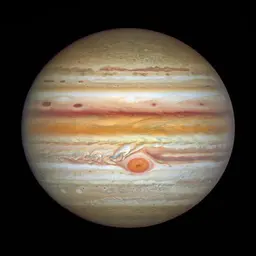 Hubble Space Telescope photo of Jupiter, 2021..Hubble’s September 4th photo of Jupiter displays the ever-changing landscape of its turbulent atmosphere, where several new storms are making their mark, and the pace of color changes near the planet’s equator is continuing to surprise researchers..The planet’s equatorial zone has remained a deep orange hue for a much longer time, compared to previous darkening episodes. While the equator has changed from its traditional white or beige appearance for a few years now, scientists were surprised to find the deeper orange color to persist in Hubble’s recent imaging, instead expecting the zone to lose its reddish haze layer..Just above the equator, researchers note the appearance of several new storms, nicknamed “barges” during the Voyager era. These elongated red cells can be defined as cyclonic vortexes, which vary in appearance. While some of the storms are sharply defined and clear, others are fuzzy and hazy. This difference in appearance is caused by the properties within the clouds of the vortexes. .Researchers also note that a feature dubbed “Red Spot Jr.” (Oval BA), below the Great Red Spot, where Hubble just discovered winds are speeding up, is still a darker beige color, and is joined by a string of white, anticyclonic storms to the south. Hubble Space Telescope photo of Jupiter, 2021..Hubble’s September 4th photo of Jupiter displays the ever-changing landscape of its turbulent atmosphere, where several new storms are making their mark, and the pace of color changes near the planet’s equator is continuing to surprise researchers..The planet’s equatorial zone has remained a deep orange hue for a much longer time, compared to previous darkening episodes. While the equator has changed from its traditional white or beige appearance for a few years now, scientists were surprised to find the deeper orange color to persist in Hubble’s recent imaging, instead expecting the zone to lose its reddish haze layer..Just above the equator, researchers note the appearance of several new storms, nicknamed “barges” during the Voyager era. These elongated red cells can be defined as cyclonic vortexes, which vary in appearance. While some of the storms are sharply defined and clear, others are fuzzy and hazy. This difference in appearance is caused by the properties within the clouds of the vortexes. .Researchers also note that a feature dubbed “Red Spot Jr.” (Oval BA), below the Great Red Spot, where Hubble just discovered winds are speeding up, is still a darker beige color, and is joined by a string of white, anticyclonic storms to the south. | STScI-01FM5S8CBBRXESHZW4R3H3Z27D Jupiter Hubble Space Telescope.webp |
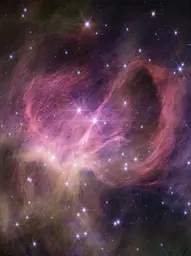 This image from the NIRCam (Near-Infrared Camera) instrument on NASA’s James Webb Space Telescope shows the central portion of the star cluster IC 348. Astronomers combed the cluster in search of tiny, free-floating brown dwarfs: objects too small to be stars but larger than most planets. They found three brown dwarfs that are less than eight times the mass of Jupiter. The smallest weighs just three to four times Jupiter, challenging theories for star formation..The wispy curtains filling the image are interstellar material reflecting the light from the cluster’s stars – what is known as a reflection nebula. The material also includes carbon-containing molecules known as polycyclic aromatic hydrocarbons, or PAHs. The bright star closest to the center of the frame is actually a pair of type B stars in a binary system, which are the most massive stars in the cluster. Winds from these stars may help sculpt the large loop seen on the right side of the field of view..Credits.Image.NASA, ESA, CSA, STScI, Kevin Luhman (PSU), Catarina Alves de Oliveira (ESA)..https://webbtelescope.org/contents/media/images/2023/151/01HFC82GPW3B8RPAJ3VWXJEAHZ?news=true. This image from the NIRCam (Near-Infrared Camera) instrument on NASA’s James Webb Space Telescope shows the central portion of the star cluster IC 348. Astronomers combed the cluster in search of tiny, free-floating brown dwarfs: objects too small to be stars but larger than most planets. They found three brown dwarfs that are less than eight times the mass of Jupiter. The smallest weighs just three to four times Jupiter, challenging theories for star formation..The wispy curtains filling the image are interstellar material reflecting the light from the cluster’s stars – what is known as a reflection nebula. The material also includes carbon-containing molecules known as polycyclic aromatic hydrocarbons, or PAHs. The bright star closest to the center of the frame is actually a pair of type B stars in a binary system, which are the most massive stars in the cluster. Winds from these stars may help sculpt the large loop seen on the right side of the field of view..Credits.Image.NASA, ESA, CSA, STScI, Kevin Luhman (PSU), Catarina Alves de Oliveira (ESA)..https://webbtelescope.org/contents/media/images/2023/151/01HFC82GPW3B8RPAJ3VWXJEAHZ?news=true. | STScI-01HFC8K9A4CX579GP4QMDX2QBY JWST Photo IC348 CC-BY NASA.webp |
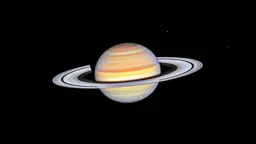 This photo of Saturn was taken by NASA's Hubble Space Telescope on October 22, 2023, when the ringed planet was approximately 850 million miles from Earth. Hubble's ultra-sharp vision reveals a phenomenon called ring spokes..Saturn's spokes are transient features that rotate along with the rings. Their ghostly appearance only persists for two or three rotations around Saturn. During active periods, freshly-formed spokes continuously add to the pattern. This photo of Saturn was taken by NASA's Hubble Space Telescope on October 22, 2023, when the ringed planet was approximately 850 million miles from Earth. Hubble's ultra-sharp vision reveals a phenomenon called ring spokes..Saturn's spokes are transient features that rotate along with the rings. Their ghostly appearance only persists for two or three rotations around Saturn. During active periods, freshly-formed spokes continuously add to the pattern. | STScI-01HGXC6BFXWQ6KFGXBPTRN6MCQ Hubble Space Telescope Photo of Saturn.webp |
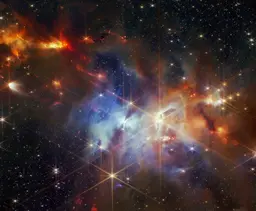 | STScI-01HYGJ1DYP32NPPSVFMYGC8WVB Serpens Nebula Discovery 2024 CC-BY NASA.webp |
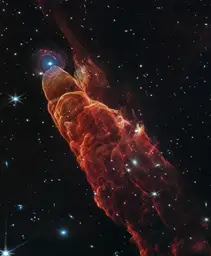 From https://webbtelescope.org/contents/media/images/2025/112/01JNGTQ49XY0NHG1Y31RAGYH1Y?Year=2025&itemsPerPage=15&page=1 From https://webbtelescope.org/contents/media/images/2025/112/01JNGTQ49XY0NHG1Y31RAGYH1Y?Year=2025&itemsPerPage=15&page=1 | STScI-01JNGVAQKT0ATWEE89D918J3HF JWST Photo Herbig-Haro 49-50.webp |
 converted PNM file converted PNM file | Wikimedia Center_of_the_Milky_Way_Galaxy_IV_–_Composite CC-BY NASA.jpg |
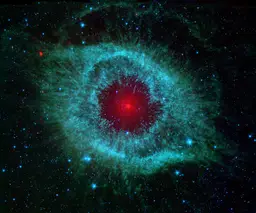 This infrared image from NASA's Spitzer Space Telescope shows the Helix nebula, a cosmic starlet often photographed by amateur astronomers for its vivid colors and eerie resemblance to a giant eye. ..The nebula, located about 700 light-years away in the constellation Aquarius, belongs to a class of objects called planetary nebulae. Discovered in the 18th century, these cosmic butterflies were named for their resemblance to gas-giant planets. ..Planetary nebulae are actually the remains of stars that once looked a lot like our sun. .When sun-like stars die, they puff out their outer gaseous layers. These layers are heated by the hot core of the dead star, called a white dwarf, and shine with infrared and visible-light colors. Our own sun will blossom into a planetary nebula when it dies in about five billion years. ..In Spitzer's infrared view of the Helix nebula, the eye looks more like that of a green monster's. Infrared light from the outer gaseous layers is represented in blues and greens. The white dwarf is visible as a tiny white dot in the center of the picture. The red color in the middle of the eye denotes the final layers of gas blown out when the star died. ..The brighter red circle in the very center is the glow of a dusty disk circling the white dwarf (the disk itself is too small to be resolved). This dust, discovered by Spitzer's infrared heat-seeking vision, was most likely kicked up by comets that survived the death of their star. Before the star died, its comets and possibly planets would have orbited the star in an orderly fashion. But when the star blew off its outer layers, the icy bodies and outer planets would have been tossed about and into each other, resulting in an ongoing cosmic dust storm. Any inner planets in the system would have burned up or been swallowed as their dying star expanded. ..The Helix nebula is one of only a few dead-star systems in which evidence for comet survivors has been found. ..This image is made up of data from Spitzer's infrared array camera and multiband imaging photometer. Blue shows infrared light of 3.6 to 4.5 microns; green shows infrared light of 5.8 to 8 microns; and red shows infrared light of 24 microns. . This infrared image from NASA's Spitzer Space Telescope shows the Helix nebula, a cosmic starlet often photographed by amateur astronomers for its vivid colors and eerie resemblance to a giant eye. ..The nebula, located about 700 light-years away in the constellation Aquarius, belongs to a class of objects called planetary nebulae. Discovered in the 18th century, these cosmic butterflies were named for their resemblance to gas-giant planets. ..Planetary nebulae are actually the remains of stars that once looked a lot like our sun. .When sun-like stars die, they puff out their outer gaseous layers. These layers are heated by the hot core of the dead star, called a white dwarf, and shine with infrared and visible-light colors. Our own sun will blossom into a planetary nebula when it dies in about five billion years. ..In Spitzer's infrared view of the Helix nebula, the eye looks more like that of a green monster's. Infrared light from the outer gaseous layers is represented in blues and greens. The white dwarf is visible as a tiny white dot in the center of the picture. The red color in the middle of the eye denotes the final layers of gas blown out when the star died. ..The brighter red circle in the very center is the glow of a dusty disk circling the white dwarf (the disk itself is too small to be resolved). This dust, discovered by Spitzer's infrared heat-seeking vision, was most likely kicked up by comets that survived the death of their star. Before the star died, its comets and possibly planets would have orbited the star in an orderly fashion. But when the star blew off its outer layers, the icy bodies and outer planets would have been tossed about and into each other, resulting in an ongoing cosmic dust storm. Any inner planets in the system would have burned up or been swallowed as their dying star expanded. ..The Helix nebula is one of only a few dead-star systems in which evidence for comet survivors has been found. ..This image is made up of data from Spitzer's infrared array camera and multiband imaging photometer. Blue shows infrared light of 3.6 to 4.5 microns; green shows infrared light of 5.8 to 8 microns; and red shows infrared light of 24 microns. . | Wikimedia Comets_Kick_up_Dust_in_Helix_Nebula_(PIA09178) CC-BY NASA.jpg |
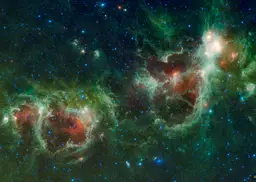 | Wikimedia Heart_and_Soul_nebulae CC-BY NASA.jpg |
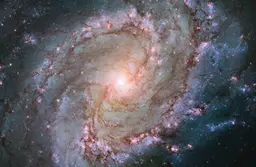 This new Hubble image shows the scatterings of bright stars and thick dust that make up spiral galaxy Messier 83, otherwise known as the Southern Pinwheel Galaxy. One of the largest and closest barred spirals to us, this galaxy is dramatic and mysterious; it has hosted a large number of supernova explosions, and appears to have a double nucleus lurking at its core. This new Hubble image shows the scatterings of bright stars and thick dust that make up spiral galaxy Messier 83, otherwise known as the Southern Pinwheel Galaxy. One of the largest and closest barred spirals to us, this galaxy is dramatic and mysterious; it has hosted a large number of supernova explosions, and appears to have a double nucleus lurking at its core. | Wikimedia Messier83_-_Heic1403a PD NASA (Smaller).jpg |
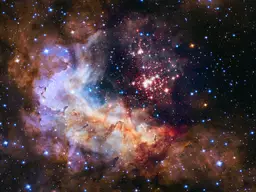 | Wikimedia NASA_Unveils_Celestial_Fireworks_as_Official_Hubble_25th_Anniversary_Image CC-BY NASA.jpg |
 | Wikimedia NASA-Apollo8-Dec24-Earthrise CC-BY NASA.jpg |
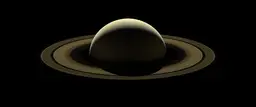 | Wikimedia PIA17218_–_A_Farewell_to_Saturn,_Brightened_Version CC-BY NASA.jpg |
 New Moon..Cameradate: Saturday, April 25, 2020 21:45.
 Hours of Star Rotation Night Sky - Desert Australia
 Most Amazing High Definition Image of Earth - Blue Marble 2012...A 'Blue Marble' image of the Earth taken from the VIIRS instrument aboard NASA's most recently launched Earth-observing satellite - Suomi NPP. This composite image uses a number of swaths of the Earth's surface taken on January 4, 2012. The NPP satellite was renamed 'Suomi NPP' on January 24, 2012 to honor the late Verner E. Suomi of the University of Wisconsin...Credit: NASA/NOAA/GSFC/Suomi NPP/VIIRS/Norman Kuring.
 Magnificent CME Erupts on the Sun - August 31.Solar Flare.On August 31, 2012 a long filament of solar material that had been hovering in the sun's atmosphere, the corona, erupted out into space at 4:36 p.m. EDT. The coronal mass ejection, or CME, traveled at over 900 miles per second. The CME did not travel directly toward Earth, but did connect with Earth's magnetic environment, or magnetosphere, causing aurora to appear on the night of Monday, September 3.. .Pictured here is a lighten blended version of the 304 and 171 angstrom wavelengths. Cropped.
 This image from June 20, 2013, at 11:15 p.m. EDT shows the bright light of a solar flare on the left side of the sun and an eruption of solar material shooting through the sun’s atmosphere, called a prominence eruption. Shortly thereafter, this same region of the sun sent a coronal mass ejection out into space.

 FD10_Lunar flyby Koch SN 1015 long lens
 FD10_Lunar flyby Koch SN 1015 long lens
 FD07_FD6 Lunar flyby imagry - D5 short lens 1022 Koch, wiseman, glover -wrong SN these are Z9
 Landing Day for InSight.NASA's InSight spacecraft will complete its seven-month journey to Mars today. It will have cruised 301,223,981 miles (484,773,006 km) at a top speed of 6,200 mph (10,000 kph). Launched on May 5, InSight is the first spacecraft built to study Mars' deep interior. The landing will kick off a two-year mission that will help scientists understand the formation of the Red Planet and all rocky planets, including Earth. NASA's Jet Propulsion Laboratory manages the InSight mission for the agency's Science Mission Directorate. InSight is part of NASA's Discovery Program, managed by the Planetary Missions Program Office at Marshall Space Flight Center.. .This mosaic is composed of 102 Viking Orbiter images of Mars. The center of the scene (lat -8, long 78) shows the entire Valles Marineris canyon system, over 2000 kilometers long and up to 8 kilometers deep, extending form Noctis Labyrinthus, the arcuate system of graben to the west, to the chaotic terrain to the east.. .Image credit: NASA/JPL-Caltech
 Curiosity’s Selfie at Mont Mercou.NASA’s Curiosity Mars rover used two different cameras to create this selfie in front of Mont Mercou, a rock outcrop that stands 20 feet (6 meters) tall. The panorama is made up of 60 images taken by the Mars Hand Lens Imager (MAHLI) on the rover’s robotic arm on March 26, 2021, the 3,070th Martian day, or sol, of the mission. These were combined with 11 images taken by the Mastcam on the mast, or “head,” of the rover on March 16, 2021, the 3,060th Martian day of the mission.. .The hole visible to the left of the rover is where its robotic drill sampled a rock nicknamed “Nontron.” The Curiosity team is nicknaming features in this part of Mars using names from the region around the village of Nontron in southwestern France.. .Curiosity was built by NASA’s Jet Propulsion Laboratory in Southern California. Caltech in Pasadena, California, manages JPL for NASA. JPL manages Curiosity's mission for NASA’s Science Mission Directorate in Washington. MAHLI was built by Malin Space Science Systems in San Diego.. .Image Credit: NASA/JPL-Caltech
 Carina Nebula (High resolution)..Image Description:.The image is divided horizontally by an undulating line between a cloudscape forming a nebula along the bottom portion and a comparatively clear upper portion. Speckled across both portions is a starfield, showing innumerable stars of many sizes. The smallest of these are small, distant, and faint points of light. The largest of these appear larger, closer, brighter, and more fully resolved with 8-point diffraction spikes. The upper portion of the image is blueish, and has wispy translucent cloud-like streaks rising from the nebula below. The orangish cloudy formation in the bottom half varies in density and ranges from translucent to opaque. The stars vary in color, the majority of which have a blue or orange hue. The cloud-like structure of the nebula contains ridges, peaks, and valleys – an appearance very similar to a mountain range. Three long diffraction spikes from the top right edge of the image suggest the presence of a large star just out of view.. .Credits: NASA, ESA, CSA, and STScI
 This image from the NASA/ESA/CSA James Webb Space Telescope shows the heart of M74, otherwise known as the Phantom Galaxy. Webb’s sharp vision has revealed delicate filaments of gas and dust in the grandiose spiral arms which wind outwards from the centre of this image. A lack of gas in the nuclear region also provides an unobscured view of the nuclear star cluster at the galaxy's centre. M74 is a particular class of spiral galaxy known as a ‘grand design spiral’, meaning that its spiral arms are prominent and well-defined, unlike the patchy and ragged structure seen in some spiral galaxies. The Phantom Galaxy is around 32 million light-years away from Earth in the constellation Pisces, and lies almost face-on to Earth. This, coupled with its well-defined spiral arms, makes it a favourite target for astronomers studying the origin and structure of galactic spirals. Webb gazed into M74 with its Mid-InfraRed Instrument (MIRI) in order to learn more about the earliest phases of star formation in the local Universe. These observations are part of a larger effort to chart 19 nearby star-forming galaxies in the infrared by the international PHANGS collaboration. Those galaxies have already been observed using the NASA/ESA Hubble Space Telescope and ground-based observatories. The addition of crystal-clear Webb observations at longer wavelengths will allow astronomers to pinpoint star-forming regions in the galaxies, accurately measure the masses and ages of star clusters, and gain insights into the nature of the small grains of dust drifting in interstellar space.Hubble observations of M74 have revealed particularly bright areas of star formation known as HII regions. Hubble’s sharp vision at ultraviolet and visible wavelengths complements Webb’s unparalleled sensitivity at infrared wavelengths, as do observations from ground-based radio telescopes such as the Atacama Large Millimeter/submillimeter Array, ALMA. By combining data from telescopes operating across the electromagnetic spectrum, scientists can gain greater insight into astronomical objects than by using a single observatory — even one as powerful as Webb! MIRI was contributed by ESA and NASA, with the instrument designed and built by a consortium of nationally funded European Institutes (the MIRI European Consortium) in partnership with JPL and the University of Arizona. Links Pan of the Phantom Galaxy Image B Image C
 A Cosmic Tarantula, Caught by NASA’s Webb..Image description: A space image captured by the Webb telescope. Fluffy tan-colored nebula clouds, with rust-colored highlights, surround a black central area. Within that area, the focal point of the image is one large yellow star with eight long thin points. To the right of this star is a bright star cluster in an oval shape. The stars within the cluster look like tiny pale blue sparkles. The cluster is more densely packed at its core and scatters outward. Towards the bottom of the image, multiple arms appear to spiral out of a cloudy tan knob, resembling a spider or a squid structure. Other blue and yellow eight-pointed stars, as well as distant galaxies, are dotted throughout the image...Image Credit: NASA, ESA, CSA, STScI, Webb ERO Production Team...
 NASA’s Webb Unveils Young Stars in Early Stages of Formation..Image description: The image is divided horizontally by an undulating line between a cloudscape forming a nebula along the bottom portion and a comparatively clear upper portion. Speckled across both portions is a starfield. The upper portion of the image is blueish, and has wispy translucent cloud-like streaks rising from the nebula below. The orangish cloudy formation in the bottom half varies in density and ranges from translucent to opaque. The cloud-like structure of the nebula contains ridges, peaks, and valleys – an appearance very similar to a mountain range...Credits: NASA, ESA, CSA, STScI, Megan Reiter (Rice University), with image processing by Joseph DePasquale (STScI), Anton M. Koekemoer (STScI).
 The Enduring Stellar Lifecycle in 30 Doradus (Composite: Infrared + X-ray)..Image description: Composite image of the Tarantula Nebula: Royal blue and purple gas clouds interact with red and orange gas clouds, as specks of light and large gleaming stars peek through. The blue and purple patches represent X-ray data from Chandra. The most striking blue cloud is shaped like an upward pointing triangle at the center. Wispy white clouds outline this blue triangle. Inside this frame is a gleaming star with six long, thin spikes. Beside it is a cluster of smaller bright blue specks showing young stars in the nebula. Darker X-ray clouds can be found near the right and left edges of the image. The red and orange gas clouds, which look like roiling fire, represent infrared data from Webb...Image credit: X-ray: NASA/CXC/Penn State Univ./L. Townsley et al.; IR: NASA/ESA/CSA/STScI/JWST ERO Production Team..
 Webb Unveils Dark Side of Pre-stellar Ice Chemistry..Image description: A Webb image of the central region of the Chamaeleon I dark molecular cloud, which resides 630 light-years away. This image primarily shows blue smoky wisps on a dark background. The left top side additionally features orange and white wisps. Just below them are four bright points of light. Three are orange and one is a mix of white and orange. Each of these points have Webb’s signature 8-point diffraction spikes emanating around them in long, thick orange lines, so that they look like huge snowflakes. Scattered throughout the image are distant stars or galaxies in shades of red, orange and blue, seen as tiny blobs...Image Credit: NASA, ESA, CSA, and M. Zamani (ESA). Science: M. K. McClure (Leiden Observatory), F. Sun (Steward Observatory), Z. Smith (Open University), and the Ice Age ERS Team..
 NASA’s Webb Reveals Intricate Networks of Gas and Dust in Nearby Galaxies..Image description:.A gray spiral galaxy with a bright white, circular core. Its spiral arms resemble spider web threads. Red dots are scattered throughout the black background...Credit: Science - NASA, ESA, CSA, and J. Lee (NOIRLab). Image processing - A. Pagan (STScI)
 NASA’s Webb Proves Galaxies Transformed the Early Universe..Image description: More than 20,000 tiny galaxies appear across the black background of space. The galaxy colors vary. Some of the smallest galaxies are shades of orange and pink. Most galaxies are so distant they appear as single points of light. Slightly larger, fuzzier galaxies appear whiter. Some have distinct spiral arms. In front of the galaxies are several foreground stars, though none appear larger than the largest galaxies. The foreground stars are scattered around the image, appear blue and have eight prominent diffraction spikes. At the center is a pink object with six diffraction spikes. This is quasar J0100+2802. It appears slightly smaller than the blue foreground stars...Credit: NASA, ESA, CSA, Simon Lilly (ETH Zurich), Daichi Kashino (Nagoya University), Jorryt Matthee (ETH Zurich), Christina Eilers (MIT), Rob Simcoe (MIT), Rongmon Bordoloi (North Carolina State University), Ruari Mackenzie (ETH Zurich). Image processing: Alyssa Pagan (STScI), Ruari Mackenzie (ETH Zurich).
 Webb Celebrates First Year of Science With Close-up on Birth of Sun-like Stars..Image description: Red dual opposing jets coming from young stars fill the darker top half of the image. At bottom center is a glowing pale yellow, cave-like structure, its top tilted toward two o’clock, with a bright star at its center. The dust of the cave structure becomes wispy toward eight o’clock. Above the arched top of the dust cave, 3 groupings of stars with diffraction spikes are arranged. A dark cloud sits at the top of the arch of the glowing dust cave, with one streamer curling down the right-hand side. The dark shadow of the cloud appears pinched in the center, with light emerging in a triangle shape above and below the pinch, revealing the presence of a star inside the cloud. The largest jets of red material emanate from within this dark cloud, thick and displaying structure like the rough face of a cliff, glowing brighter at the edges. At top center, a star displays another, larger pinched dark shadow, this time vertically. To the left of this star is a more wispy, indistinct region...Credit: NASA, ESA, CSA, STScI, Klaus Pontoppidan (STScI), Image Processing: Alyssa Pagan (STScI).
 Webb Snaps Highly Detailed Infrared Image of Actively Forming Stars..Image description: At the center of the image is a horizontal orange cloud known as Herbig-Haro 46/47 that is uneven with rounded ends, and tilted from bottom left to top right. In the middle of this cloud is a yellow-white blob with 8 reddish pink diffraction spikes piercing through it. The left lobe of the cloud is thicker. Just off the edge is a tiny red arc that curves in the opposite direction. The right lobe is thinner, and ends in a smaller orange semi-circle that has a faint purple outline. Just off the edge of this lobe is a slightly smaller orange sponge-like blob. A delicate, semi-transparent blue cloud known as a nebula drifts toward the top of the image and peters out toward the left of the frame. Toward the right and bottom, the nebula ends in a soft ridge set off in a translucent orange. The background is filled with stars and galaxies. Two foreground stars with blue diffraction spikes, seen in the bottom right corner, are especially prominent...Credit: NASA, ESA, CSA. Image Processing: Joseph DePasquale (STScI).
 This image shows the irregular galaxy NGC 6822, as observed by the Mid-InfraRed Instrument (MIRI) mounted on the NASA/ESA/CSA James Webb Space Telescope. MIRI probes the mid-infrared, which in this case makes it perfectly suited to observe the dense regions of gas that suffuse this galaxy. At mid-infrared wavelengths the emission of light by galactic dust is prominent, obscuring the galaxy’s stars which themselves are faint at these longer wavelengths. Brilliant blue gas indicates light emitted by organic compounds called polycyclic aromatic hydrocarbons, which play a critical role in the formation of stars and planets. Cyan marks cooler patches of dust, while warmer dust is more orange. Distant galaxies far beyond NGC 6822 are displayed in orange. The few galaxies that are relatively closer, meanwhile, are marked in green by their own light-emitting dust, which MIRI can pick out. Bright red and magenta colours indicate active areas of star formation in the galaxy. With so many stars, supernova explosions are routine, and an amazing example of a supernova remnant is visible in this image: a red ring just below the centre. [Image Description: A dark field covered by many layers of billowing clouds, made of gas and dust, spread out in complex patterns. In the centre the clouds are dense and glowing; out towards the edges, they become dark and faint. Bright galaxies with various shapes and sizes shine through the clouds. Many bright stars with visible diffraction spikes are spread throughout the image.] Links Slider tool: NGC6822 (NIRCam and MIRI images) NGC 6822 (NIRCam+MIRI image)
 A FEAST for the eyes (M51/Whirlpool Galaxy)..Seen here is a composite image of galaxy M51 (also known as NGC 5194 also known as the Whirlpool) using both MIRI (Mid-Infrared Instrument) and NIRCam (Near Infrared Camera) data from the Webb telescope. The gravity of M51's neighbor, the dwarf galaxy NGC 5195, is thought to be partially responsible for those prominent and distinct spiral arms!..Image description: Composite image combining data from Webb's MIRI and NIRCam instruments. A large spiral galaxy takes up the entirety of the image. The core is mostly bright white, but there are also swirling, detailed structures that resemble water circling a drain. There is white and pale blue light that emanates from stars and dust at the core’s center, but it is tightly limited to the core. The rings feature colors of deep red and orange and highlight filaments of dust around cavernous black bubbles...Credit: ESA/Webb, NASA & CSA, A. Adamo and the FEAST JWST team..
 NASA's Webb Snaps Supersonic Outflow of Young Star..Image description: At the center is a thin horizontal pinkish cloud known as Herbig-Haro 211 that is uneven with rounded ends, and tilted from bottom left to top right. It takes up about two-thirds of the length of this angle, but is thinner and longer at the opposite angle. At its center is a dark spot. On either side of the dark spot, there are orangish yellow wisps that extend to light blue wisps. Within the center of those clouds, a pink fluffy streak runs through each lobe. At the ends of each lobe, pink becomes the dominant color. The lobe to the left is fatter. The right lobe is thinner, and ends in a smaller pink semi-circle. Just off the edge of this lobe is a slightly smaller pink semicircle, then a pink sponge-like blog. The background contains several bright stars, each with eight diffraction spikes extending out from the central bright point...Credit: ESA/Webb, NASA, CSA, T. Ray (Dublin).
 Long-wavelength NIRCam Orion mosaic in ESASky..Image description: An image of a young star-forming region filled with with wispy purple, green, and red nebulosity. The purple ionised gas is seen mostly towards the centre, with browns, greens, and reds behind, while the periphery is mostly bright green and darker brown to the left. There is a large spray of yellow, orange, red, and purple towards the top centre, and the nebula fades to near black to the right. There are thousands of stars sprinkled across the field, concentrated towards the centre, but they generally appear fainter at longer wavelengths, with some exceptions. The brightest sources in the field have extensive diffraction spikes characteristic of Webb...Image Credits: Image: NASA, ESA, CSA / Science leads and image processing: M. McCaughrean, S. Pearson, CC BY-SA 3.0 IGO.
 Pandora Cluster (NIRCam Image).Astronomers found the most distant black hole ever detected in X-rays (in a galaxy dubbed UHZ1) using the Chandra and Webb space telescopes. X-ray emission is a telltale signature of a growing supermassive black hole. This result may explain how some of the first supermassive black holes in the universe formed. This image is the infrared image from Webb only, and shows the galaxy cluster Abell 2744 that UHZ1 is located behind. For the composite Chandra/Webb image, see the feature: chandra.si.edu/photo/2023/uhz1/. .Credit: X-ray: NASA/CXC/SAO/Ákos Bogdán; Infrared: NASA/ESA/CSA/STScI; Image Processing: NASA/CXC/SAO/L. Frattare & K. Arcand. .Image description: The main image of this release features a glimpse of a black hole in an early stage of its development, just 470 million years after the Big Bang.
 NASA’s Webb, Hubble Combine to Create Most Colorful View of Universe..This image:.This panchromatic view of galaxy cluster MACS0416 was created by combining infrared observations from NASA’s James Webb Space Telescope with visible-light data from NASA’s Hubble Space Telescope. The resulting wavelength coverage, from 0.4 to 5 microns, reveals a vivid landscape of galaxies whose colors give clues to galaxy distances: The bluest galaxies are relatively nearby and often show intense star formation, as best detected by Hubble, while the redder galaxies tend to be more distant, or else contain copious amount of dust, as detected by Webb. The image reveals a wealth of details that are only possible to capture by combining the power of both space telescopes. In this image, blue represents data at wavelengths of 0.435 and 0.606 microns (Hubble filters F435W and F606W); cyan is 0.814, 0.9, and 1.05 microns (Hubble filters F814W, and F105W and Webb filter F090W); green is 1.15, 1.25, 1.4, 1.5, and 1.6 microns (Hubble filters F125W, F140W, and F160W, and Webb filters F115W and F150W); yellow is 2.00 and 2.77 microns (Webb filters F200W, and F277W); orange is 3.56 microns (Webb filter F356W); and red represents data at 4.1 and 4.44 microns (Webb filters F410M and F444W)..NASA, ESA, CSA, STScI, J. Diego (Instituto de Física de Cantabria, Spain), J. D’Silva (U. Western Australia), A. Koekemoer (STScI), J. Summers & R. Windhorst (ASU), and H. Yan (U. Missouri).. . .[Image description: A field of galaxies on the black background of space. In the middle, stretching from left to right, is a collection of dozens of yellowish spiral and elliptical galaxies that form a foreground galaxy cluster. They form a rough, flat line along the center. Among them are distorted linear features, which mostly appear to follow invisible concentric circles curving around the center of the image. The linear features are created when the light of a background galaxy is bent and magnified through gravitational lensing. At center left, a particularly prominent example stretches vertically about three times the length of a nearby galaxy. A variety of brightly colored, red and blue galaxies of various shapes are scattered across the image, making it feel densely populated. Near the center are two tiny galaxies compared to the galaxy cluster: a very red edge-on spiral and a very blue face-on spiral, which provide a striking color contrast.]..
 NASA's Webb Reveals New Features in Heart of Milky Way (NIRCAM image)..Credit: NASA, ESA, CSA, STScI, Samuel Crowe (UVA)..This image shows a field crowded with stars. A large, bright cyan-colored area surrounds the lower portion of a funnel-shaped region of space that is wider at the top edge of the image and then narrows. This funnel-shaped region appears darker than its surroundings. Toward the narrow end of this dark region a small clump of red and white appears to shoot out streamers upward and left. The cyan-colored area has needle-like structures and becomes more diffuse towards the right. The right side is dominated by clouds of orange and red, with a purple haze.
 NASA's Webb Stuns With New High-Definition Look at Exploded Star..Cassiopeia A, a round cloud of gas and dust with complex structure. The inner shell is made of bright pink and orange filaments studded with clumps and knots. Around the exterior of the inner shell, particularly at the upper right, there are curtains of wispy gas that look like campfire smoke. The white smoke-like material also appears to fill the cavity of the inner shell, featuring structures shaped like large bubbles. Around and within the nebula, there are various stars seen as points of blue and white light. Outside the nebula, there are also clumps of yellow dust, with a particularly large clump at the bottom right corner that appears to have very detailed striations...Credit: NASA, ESA, CSA, STScI, D. Milisavljevic (Purdue University), T. Temim (Princeton University), I. De Looze (Ghent University)
 This new image from the NASA/ESA/CSA James Webb Space Telescope features NGC 6440, a globular cluster that resides roughly 28 000 light-years from Earth in the constellation Sagittarius. The object was first discovered by William Herschel in May of 1786. Globular clusters like NGC 6440 are roughly spherical, tightly packed, collections of old stars bound together by gravity. They can be found throughout galaxies, but often live on the outskirts. They hold hundreds of thousands to millions of stars that are on average about one light-year apart, but they can be as close together as the size of our Solar System. NGC 6440 is known to be a high-mass and metal-rich cluster that formed and is orbiting within the Galactic bulge, which is a dense, near-spherical region of old stars in the inner part of the Milky Way. This image was obtained with 2023 data from Webb’s Near-InfraRed Camera (NIRCam) as part of an observation programme to explore the stars in the cluster and to investigate details of the cluster’s pulsars. A pulsar is a highly magnetised, rotating neutron star that emits a beam of electromagnetic radiation from their magnetic poles. To us, that beam appears as a short burst or pulse as the star rotates. Pulsars spin extremely fast. Astronomers have clocked the fastest pulsars at more than 716 rotations per second, but a pulsar could theoretically rotate as fast as 1500 rotations per second before slowly losing energy or breaking apart. The new data obtained by the science team indicate the first evidence from Webb observations of abundance variations of helium and oxygen in stars in a globular cluster. These results open the window for future, in-depth investigations of other clusters in the Galactic bulge, which were previously infeasible with other telescope facilities given the significant crowding of stars in the cluster and the strong reddening caused by interstellar dust between the cluster and Earth. [Image Description: A spherical collection of stars which fills the whole view. The cluster is dominated by a concentrated group of bright white stars at the centre, with several large yellow stars scattered throughout the image. Many of the stars have visible diffraction spikes. The background is black.] Links Star studded cluster (NIRCam image wide-field view) Slider tool: Hubble and Webb’s views of NGC 6440 Pan video: NGC 6440 Transition video: Hubble and Webb’s views of NGC 6440 Science paper


 Milky Way & Comet A3 at Sugarloaf Rock, Western Australia..CC-BY-NC-ND Trevor Dobson.https://www.flickr.com/photos/trevor_dobson_inefekt69/54457512581/in/feed-23316939-1744874324-1-72157721760667417..Nikon d810a.50mm.ISO 3200.f/2.0.Foreground: 10 x 25 seconds.Sky: 50 x 25 seconds.H-Alpha: 8 x 60 seconds.iOptron SkyTracker. .This is a 68 shot panorama of the Milky Way and comet C/2023 A3 (Tsuchinshan–ATLAS) as they both set above Sugarloaf Rock, 3 hours south of Perth in Western Australia. Venus can be seen shining very brightly just to the right of Rho Ophiuchi, enveloped by the Zodiachal Light. The red parts of the sky are hydrogen alpha emitting regions, captured with a filter that isolates that part of the spectrum, the most prominent of which is to the right around Cygnus.. .Airglow was also quite strong, thanks to the fact we are at solar maximum which not only produces more active aurora but also airglow. The cloud on the horizon quickly caught up to us and put an early end to the night, but not before we did what we drove 2.5 hours to do, thankfully.
 Galaxies from the James Webb Space Telescope, CEERS Survey crop. From https://esawebb.org/images/CEERS11/
 Hubble Celebrates 34th Anniversary with a Look at the Little Dumbbell Nebula..NASA Hubble Mission Team.Goddard Space Flight Center.APR 23, 2024.ARTICLE.In celebration of the 34th anniversary of the launch of NASA's legendary Hubble Space Telescope on April 24, astronomers took a snapshot of the Little Dumbbell Nebula (also known as Messier 76, M76, or NGC 650/651) located 3,400 light-years away in the northern circumpolar constellation Perseus. The photogenic nebula is a favorite target of amateur astronomers...From https://science.nasa.gov/missions/hubble/hubble-celebrates-34th-anniversary-with-little-dumbbell-nebula/
 converted PNM file...Original Caption Released with Image:.As MESSENGER approached Mercury for the mission's third and final flyby of the Solar System's innermost planet, the WAC acquired images through all 11 of its narrow-band color filters. The 1000, 700, and 430 nanometer filters were combined in red, green, and blue to create this color image, the last close-up color view that will be acquired until MESSENGER goes into orbit around Mercury in March of 2011. Only 6% of Mercury's surface in this image had not been viewed previously by spacecraft, and most of the measurements made by MESSENGER's other instruments during this flyby were made prior to closest approach. The observations from MESSENGER's third flyby of Mercury nonetheless revealed fresh surprises. Check out the NASA Science Update Telecon held today for details about some of these new surprises..Date Acquired: September 29, 2009.Instrument: Wide Angle Camera (WAC) of the Mercury Dual Imaging System (MDIS).WAC Filter: 9, 1, 6 (1000, 700, and 430 nanometers).Resolution: 5 kilometers/pixel (3 miles/pixel).Scale: Mercury's diameter is 4880 kilometers (3030 miles).These images are from MESSENGER, a NASA Discovery mission to conduct the first orbital study of the innermost planet, Mercury. For information regarding the use of images, see the MESSENGER image use policy..Image Credit:.NASA/Johns Hopkins University Applied Physics Laboratory/Carnegie Institution of Washington..Image Addition Date:.2009-11-03.
 This was Cassini’s view from orbit around Saturn on Jan. 2, 2010. In this image, the rings on the night side of the planet have been brightened significantly to more clearly reveal their features. On the day side, the rings are illuminated both by direct sunlight, and by light reflected off Saturn’s cloud tops..This natural-color view is a composite of images taken in visible light with the Cassini spacecraft’s narrow-angle camera at a distance of approximately 1.4 million miles (2.3 million kilometers) from Saturn.

 The Day the Earth Smiled..View of Earth through Saturn's Rings from Cassini Spacecraft...On July 19, 2013, in an event celebrated the world over, NASA's Cassini spacecraft slipped into Saturn's shadow and turned to image the planet, seven of its moons, its inner rings -- and, in the background, our home planet, Earth..With the sun's powerful and potentially damaging rays eclipsed by Saturn itself, Cassini's onboard cameras were able to take advantage of this unique viewing geometry. They acquired a panoramic mosaic of the Saturn system that allows scientists to see details in the rings and throughout the system as they are backlit by the sun. This mosaic is special as it marks the third time our home planet was imaged from the outer solar system; the second time it was imaged by Cassini from Saturn's orbit; and the first time ever that inhabitants of Earth were made aware in advance that their photo would be taken from such a great distance..With both Cassini's wide-angle and narrow-angle cameras aimed at Saturn, Cassini was able to capture 323 images in just over four hours. This final mosaic uses 141 of those wide-angle images. Images taken using the red, green and blue spectral filters of the wide-angle camera were combined and mosaicked together to create this natural-color view. A brightened version with contrast and color enhanced (Figure 1), a version with just the planets annotated (Figure 2), and an annotated version (Figure 3) are shown above..This image spans about 404,880 miles (651,591 kilometers) across..
 With this view, Cassini captured one of its last looks at Saturn and its main rings from a distance. The Saturn system has been Cassini's home for 13 years, but that journey is nearing its end..Cassini has been orbiting Saturn for nearly a half of a Saturnian year but that journey is nearing its end. This extended stay has permitted observations of the long-term variability of the planet, moons, rings, and magnetosphere, observations not possible from short, fly-by style missions..When the spacecraft arrived at Saturn in 2004, the planet's northern hemisphere, seen here at top, was in darkness, just beginning to emerge from winter (see Cassini's Holiday Greetings). Now at journey's end, the entire north pole is bathed in the continuous sunlight of summer..Images taken on Oct. 28, 2016 with the wide angle camera using red, green and blue spectral filters were combined to create this color view. This view looks toward the sunlit side of the rings from about 25 degrees above the ringplane..The view was acquired at a distance of approximately 870,000 miles (1.4 million kilometers) from Saturn. Image scale is 50 miles (80 kilometers) per pixel.
 As it sped away from Venus, NASA's Mariner 10 spacecraft captured this seemingly peaceful view of a planet the size of Earth, wrapped in a dense, global cloud layer. But, contrary to its serene appearance, the clouded globe of Venus is a world of intense heat, crushing atmospheric pressure and clouds of corrosive acid..This newly processed image revisits the original data with modern image processing software. A contrast-enhanced version of this view, also provided here, makes features in the planet's thick cloud cover visible in greater detail..The clouds seen here are located about 40 miles (60 kilometers) above the planet's surface, at altitudes where Earth-like atmospheric pressures and temperatures exist. They are comprised of sulfuric acid particles, as opposed to water droplets or ice crystals, as on Earth. These cloud particles are mostly white in appearance; however, patches of red-tinted clouds also can be seen. This is due to the presence of a mysterious material that absorbs light at blue and ultraviolet wavelengths. Many chemicals have been suggested for this mystery component, from sulfur compounds to even biological materials, but a consensus has yet to be reached among researchers..The clouds of Venus whip around the planet at nearly over 200 miles per hour (100 meters per second), circling the globe in about four and a half days. That these hurricane-force winds cover nearly the entire planet is another unexplained mystery, especially given that the solid planet itself rotates at a very slow 4 mph (less than 2 meters per second) — much slower than Earth's rotation rate of about 1,000 mph (450 meters per second)..The winds and clouds also blow to the west, not to the east as on the Earth. This is because the planet itself rotates to the west, backward compared to Earth and most of the other planets. As the clouds travel westward, they also typically progress toward the poles; this can be seen in the Mariner 10 view as a curved spiral pattern at mid latitudes. Near the equator, instead of long streaks, areas of more clumpy, discrete clouds can be seen, indicating enhanced upwelling and cloud formation in the equatorial region, spurred on by the enhanced power of sunlight there..This view is a false color composite created by combining images taken using orange and ultraviolet spectral filters on the spacecraft's imaging camera. These were used for the red and blue channels of the color image, respectively, with the green channel synthesized by combining the other two images..Flying past Venus en route to the first-ever flyby of Mercury, Mariner 10 became the first spacecraft to use a gravity assist to change its flight path in order to reach another planet. The images used to create this view were acquired by Mariner 10 on Feb. 7 and 8, 1974, a couple of days after the spacecraft's closest approach to Venus on Feb. 5..Despite their many differences, comparisons between Earth and Venus are valuable for helping to understand their distinct climate histories. Nearly 50 years after this view was obtained, many fundamental questions about Venus remain unanswered. Did Venus have oceans long ago? How has its atmosphere evolved over time, and when did its runaway greenhouse effect begin? How does Venus lose its heat? How volcanically and tectonically active has Venus been over the last billion years?.This image was processed from archived Mariner 10 data by JPL engineer Kevin M. Gill..The Mariner 10 mission was managed by NASA's Jet Propulsion Laboratory.
 As it sped away from Venus, NASA's Mariner 10 spacecraft captured this seemingly peaceful view of a planet the size of Earth, wrapped in a dense, global cloud layer. But, contrary to its serene appearance, the clouded globe of Venus is a world of intense heat, crushing atmospheric pressure and clouds of corrosive acid..This newly processed image revisits the original data with modern image processing software. A contrast-enhanced version of this view, also provided here, makes features in the planet's thick cloud cover visible in greater detail..The clouds seen here are located about 40 miles (60 kilometers) above the planet's surface, at altitudes where Earth-like atmospheric pressures and temperatures exist. They are comprised of sulfuric acid particles, as opposed to water droplets or ice crystals, as on Earth. These cloud particles are mostly white in appearance; however, patches of red-tinted clouds also can be seen. This is due to the presence of a mysterious material that absorbs light at blue and ultraviolet wavelengths. Many chemicals have been suggested for this mystery component, from sulfur compounds to even biological materials, but a consensus has yet to be reached among researchers..The clouds of Venus whip around the planet at nearly over 200 miles per hour (100 meters per second), circling the globe in about four and a half days. That these hurricane-force winds cover nearly the entire planet is another unexplained mystery, especially given that the solid planet itself rotates at a very slow 4 mph (less than 2 meters per second) — much slower than Earth's rotation rate of about 1,000 mph (450 meters per second)..The winds and clouds also blow to the west, not to the east as on the Earth. This is because the planet itself rotates to the west, backward compared to Earth and most of the other planets. As the clouds travel westward, they also typically progress toward the poles; this can be seen in the Mariner 10 view as a curved spiral pattern at mid latitudes. Near the equator, instead of long streaks, areas of more clumpy, discrete clouds can be seen, indicating enhanced upwelling and cloud formation in the equatorial region, spurred on by the enhanced power of sunlight there..This view is a false color composite created by combining images taken using orange and ultraviolet spectral filters on the spacecraft's imaging camera. These were used for the red and blue channels of the color image, respectively, with the green channel synthesized by combining the other two images..Flying past Venus en route to the first-ever flyby of Mercury, Mariner 10 became the first spacecraft to use a gravity assist to change its flight path in order to reach another planet. The images used to create this view were acquired by Mariner 10 on Feb. 7 and 8, 1974, a couple of days after the spacecraft's closest approach to Venus on Feb. 5..Despite their many differences, comparisons between Earth and Venus are valuable for helping to understand their distinct climate histories. Nearly 50 years after this view was obtained, many fundamental questions about Venus remain unanswered. Did Venus have oceans long ago? How has its atmosphere evolved over time, and when did its runaway greenhouse effect begin? How does Venus lose its heat? How volcanically and tectonically active has Venus been over the last billion years?.This image was processed from archived Mariner 10 data by JPL engineer Kevin M. Gill..The Mariner 10 mission was managed by NASA's Jet Propulsion Laboratory.
 Hubble Space Telescope photo of Jupiter, 2021..Hubble’s September 4th photo of Jupiter displays the ever-changing landscape of its turbulent atmosphere, where several new storms are making their mark, and the pace of color changes near the planet’s equator is continuing to surprise researchers..The planet’s equatorial zone has remained a deep orange hue for a much longer time, compared to previous darkening episodes. While the equator has changed from its traditional white or beige appearance for a few years now, scientists were surprised to find the deeper orange color to persist in Hubble’s recent imaging, instead expecting the zone to lose its reddish haze layer..Just above the equator, researchers note the appearance of several new storms, nicknamed “barges” during the Voyager era. These elongated red cells can be defined as cyclonic vortexes, which vary in appearance. While some of the storms are sharply defined and clear, others are fuzzy and hazy. This difference in appearance is caused by the properties within the clouds of the vortexes. .Researchers also note that a feature dubbed “Red Spot Jr.” (Oval BA), below the Great Red Spot, where Hubble just discovered winds are speeding up, is still a darker beige color, and is joined by a string of white, anticyclonic storms to the south.
 This image from the NIRCam (Near-Infrared Camera) instrument on NASA’s James Webb Space Telescope shows the central portion of the star cluster IC 348. Astronomers combed the cluster in search of tiny, free-floating brown dwarfs: objects too small to be stars but larger than most planets. They found three brown dwarfs that are less than eight times the mass of Jupiter. The smallest weighs just three to four times Jupiter, challenging theories for star formation..The wispy curtains filling the image are interstellar material reflecting the light from the cluster’s stars – what is known as a reflection nebula. The material also includes carbon-containing molecules known as polycyclic aromatic hydrocarbons, or PAHs. The bright star closest to the center of the frame is actually a pair of type B stars in a binary system, which are the most massive stars in the cluster. Winds from these stars may help sculpt the large loop seen on the right side of the field of view..Credits.Image.NASA, ESA, CSA, STScI, Kevin Luhman (PSU), Catarina Alves de Oliveira (ESA)..https://webbtelescope.org/contents/media/images/2023/151/01HFC82GPW3B8RPAJ3VWXJEAHZ?news=true.
 This photo of Saturn was taken by NASA's Hubble Space Telescope on October 22, 2023, when the ringed planet was approximately 850 million miles from Earth. Hubble's ultra-sharp vision reveals a phenomenon called ring spokes..Saturn's spokes are transient features that rotate along with the rings. Their ghostly appearance only persists for two or three rotations around Saturn. During active periods, freshly-formed spokes continuously add to the pattern.
 From https://webbtelescope.org/contents/media/images/2025/112/01JNGTQ49XY0NHG1Y31RAGYH1Y?Year=2025&itemsPerPage=15&page=1
 converted PNM file
 This infrared image from NASA's Spitzer Space Telescope shows the Helix nebula, a cosmic starlet often photographed by amateur astronomers for its vivid colors and eerie resemblance to a giant eye. ..The nebula, located about 700 light-years away in the constellation Aquarius, belongs to a class of objects called planetary nebulae. Discovered in the 18th century, these cosmic butterflies were named for their resemblance to gas-giant planets. ..Planetary nebulae are actually the remains of stars that once looked a lot like our sun. .When sun-like stars die, they puff out their outer gaseous layers. These layers are heated by the hot core of the dead star, called a white dwarf, and shine with infrared and visible-light colors. Our own sun will blossom into a planetary nebula when it dies in about five billion years. ..In Spitzer's infrared view of the Helix nebula, the eye looks more like that of a green monster's. Infrared light from the outer gaseous layers is represented in blues and greens. The white dwarf is visible as a tiny white dot in the center of the picture. The red color in the middle of the eye denotes the final layers of gas blown out when the star died. ..The brighter red circle in the very center is the glow of a dusty disk circling the white dwarf (the disk itself is too small to be resolved). This dust, discovered by Spitzer's infrared heat-seeking vision, was most likely kicked up by comets that survived the death of their star. Before the star died, its comets and possibly planets would have orbited the star in an orderly fashion. But when the star blew off its outer layers, the icy bodies and outer planets would have been tossed about and into each other, resulting in an ongoing cosmic dust storm. Any inner planets in the system would have burned up or been swallowed as their dying star expanded. ..The Helix nebula is one of only a few dead-star systems in which evidence for comet survivors has been found. ..This image is made up of data from Spitzer's infrared array camera and multiband imaging photometer. Blue shows infrared light of 3.6 to 4.5 microns; green shows infrared light of 5.8 to 8 microns; and red shows infrared light of 24 microns. .
 This new Hubble image shows the scatterings of bright stars and thick dust that make up spiral galaxy Messier 83, otherwise known as the Southern Pinwheel Galaxy. One of the largest and closest barred spirals to us, this galaxy is dramatic and mysterious; it has hosted a large number of supernova explosions, and appears to have a double nucleus lurking at its core.

